Day #12 New Guinea Adventure

Rabaul, Papua New Guinea

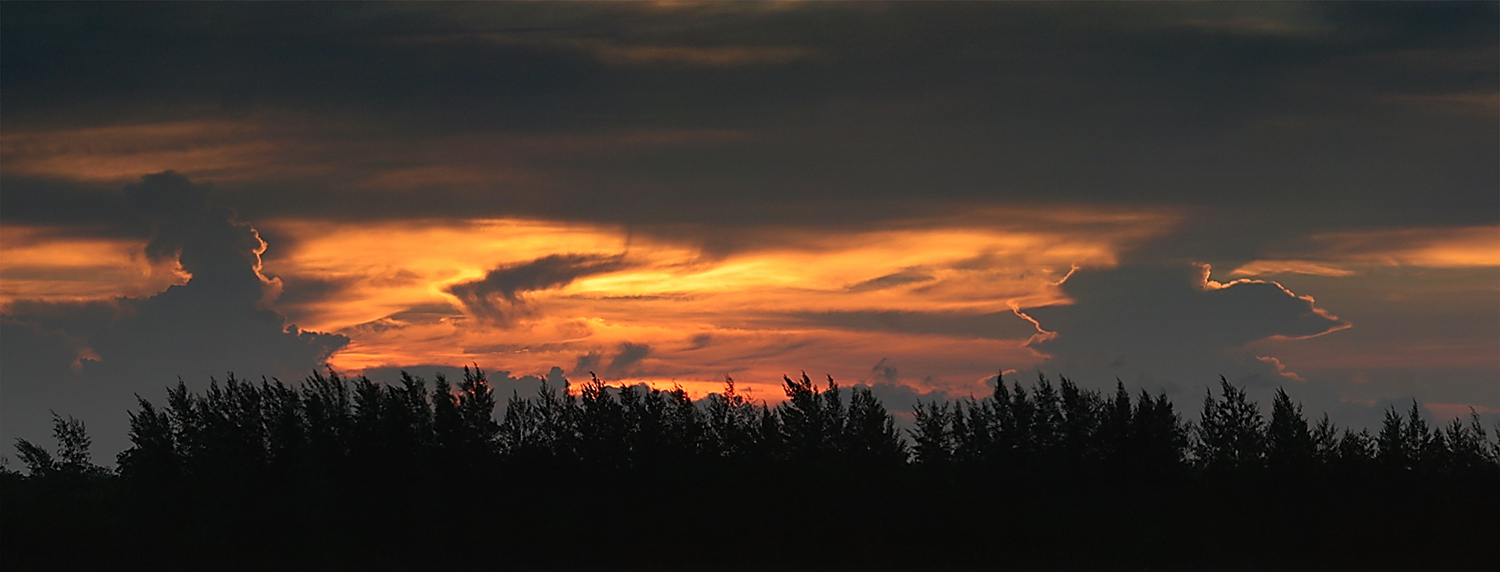
Woops almost missed the sunrise again but I managed to get my gear set up to capture what was one of the best we’ve seen so far.
Sunrise over the Bismark Sea

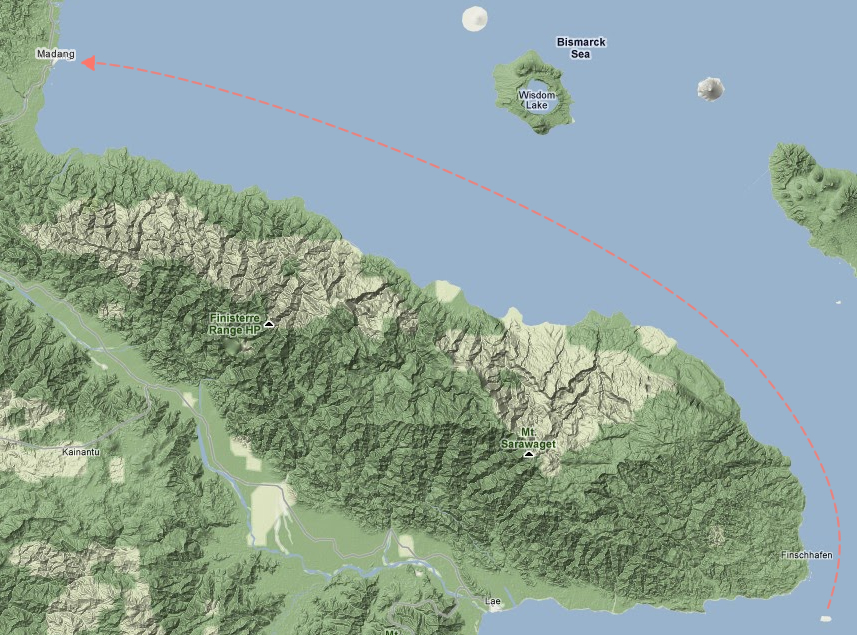
Today we finish the last leg of our backtrack East with Rabaul as our final destination later in the day. For now, we are heading toward a small island off the coast of New Britain called Little Pigeon Island.
Map of the region showing our headingGoogle map link

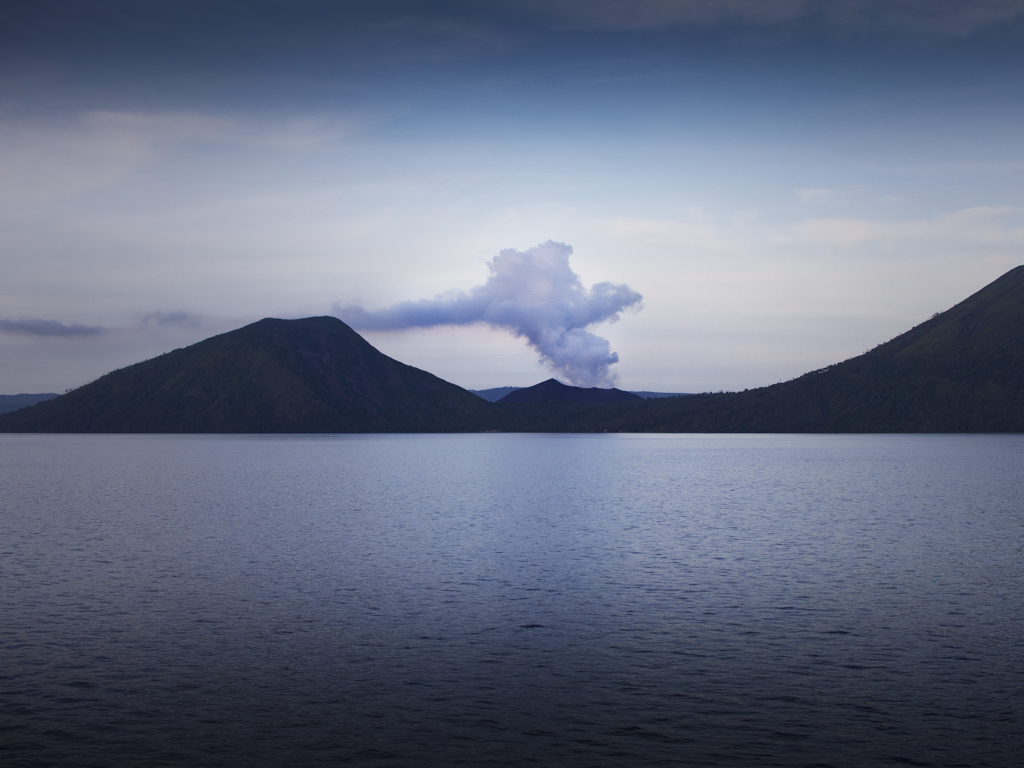
To get to the island we steam pass Atalikiun Bay and I can see the steam rising from Tavurvur volcano high into the early morning sky.
Steaming Tavurvur volcano

It’s an early start and by 08:00 Captain Frank has anchored Orion off Little Pigeon Island and we are ready to disembark for some swimming and snorkelling.

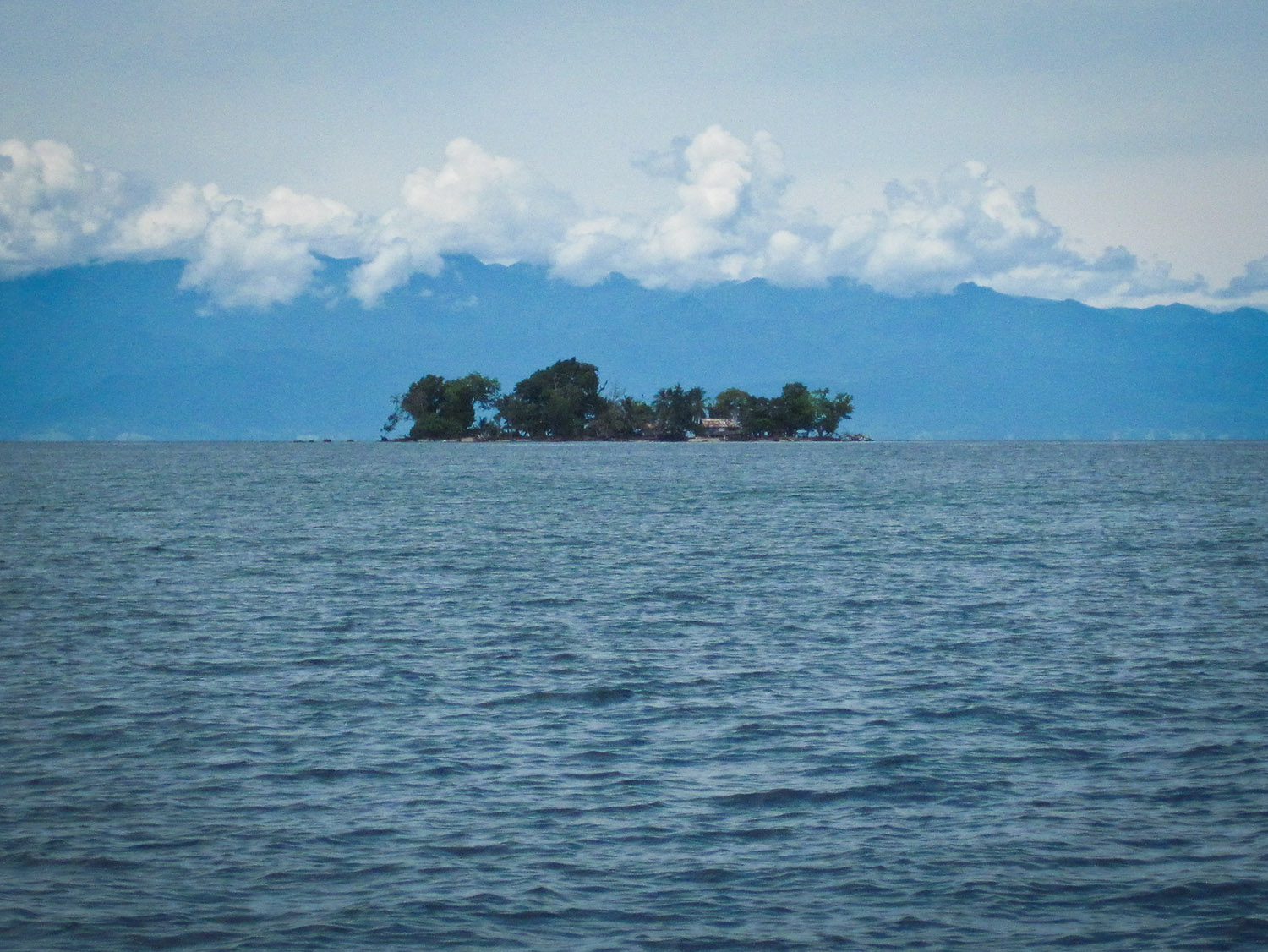
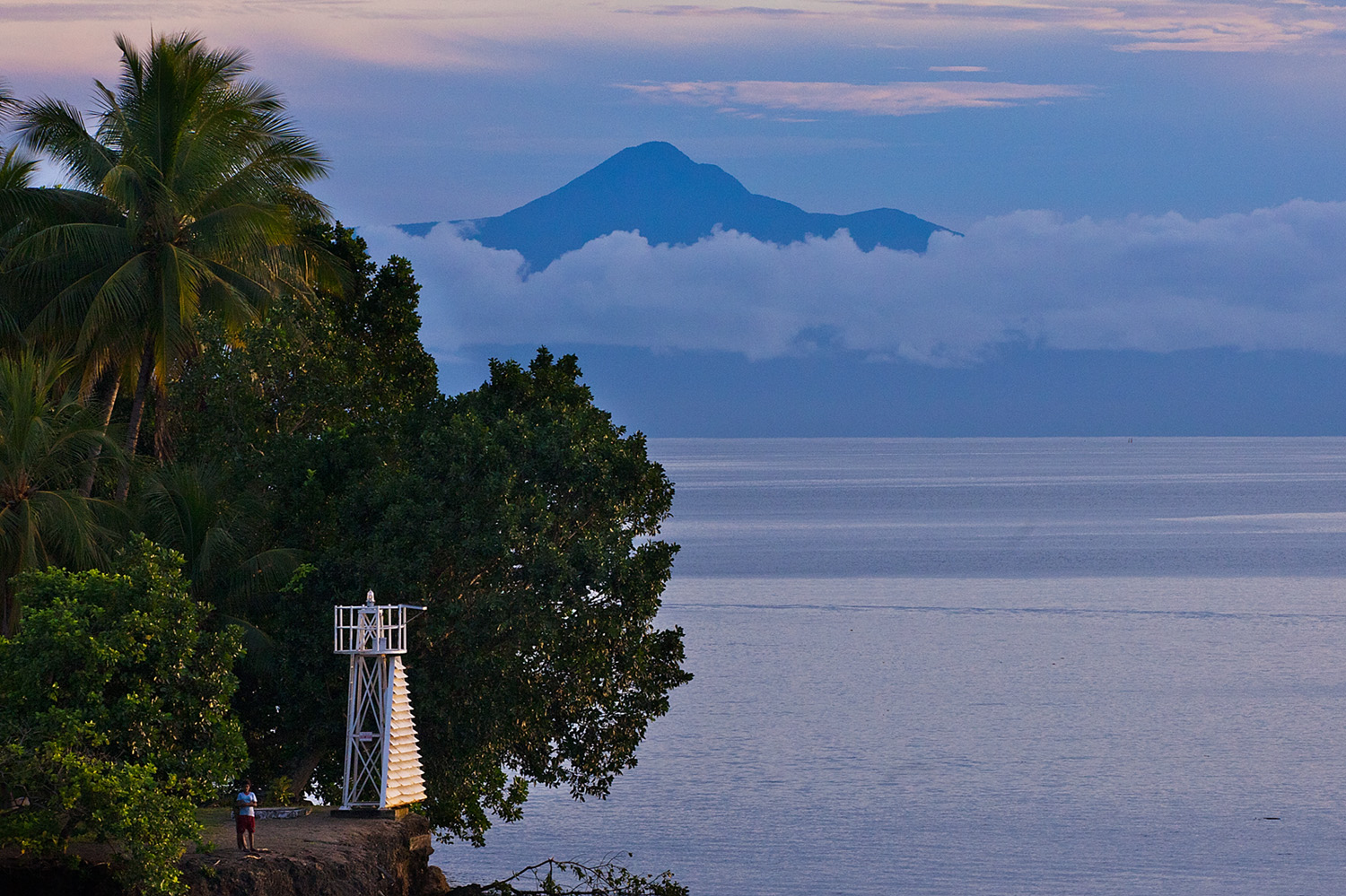
Little Pigeon Island is only about an hour from Rabaul and we can see the peaks of the volcanoes in the distance.

Map showing the postion of Little Pigeon Island relative to Rabaul

It’s another beautiful morning and we can’t wait to hit the water. There’s a very strategically placed fallen tree trunk right on the water’s edge that makes it a great spot to sit and get your gear on.
Bruce and Diane practice breathing through their snorkels

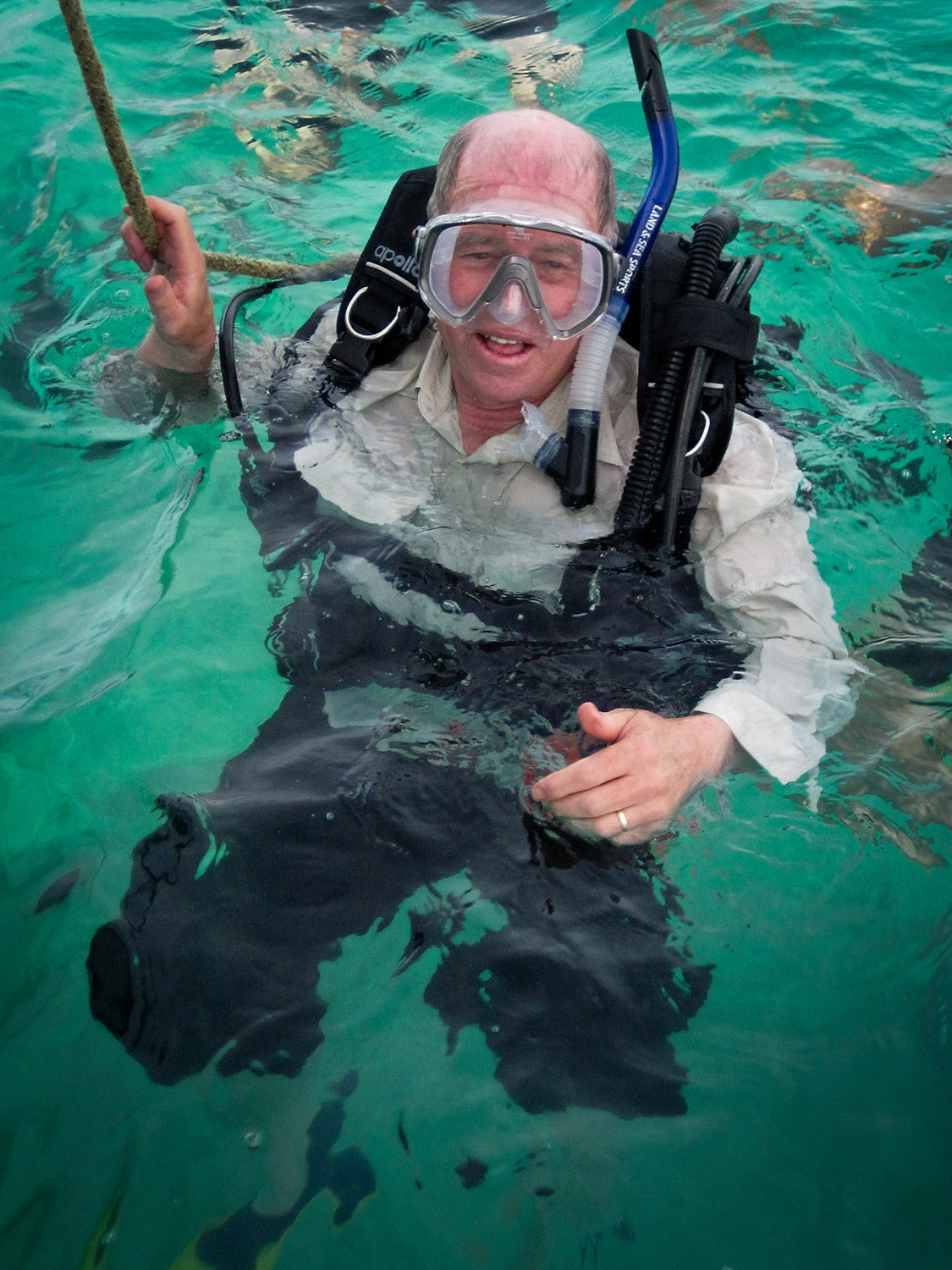
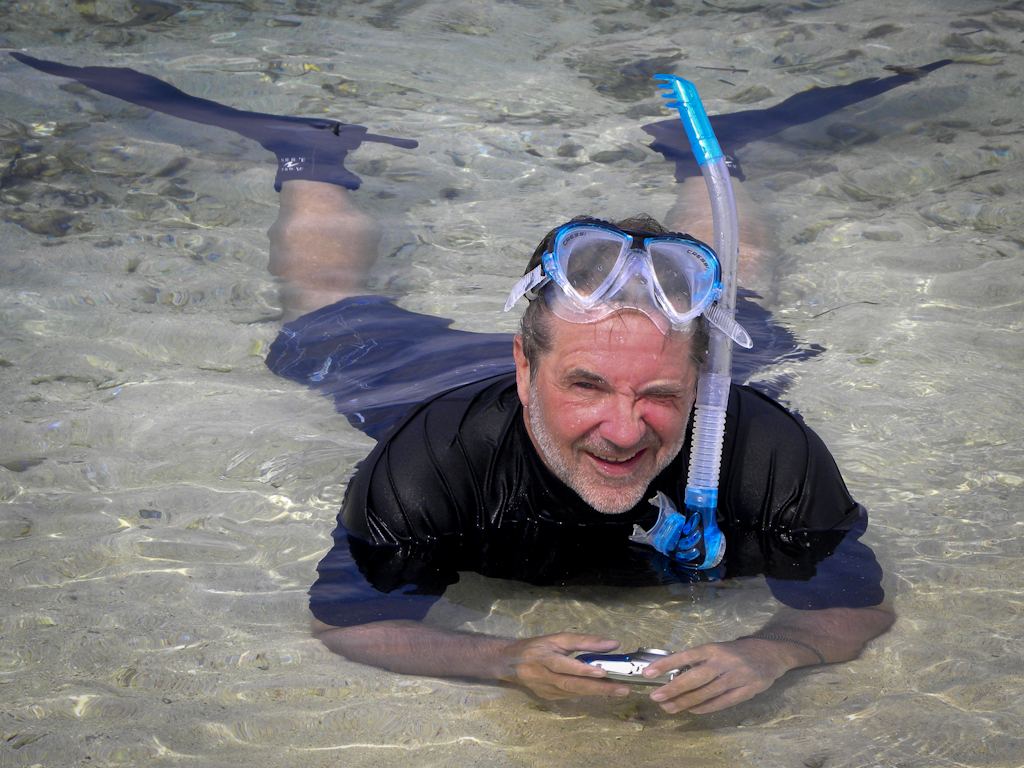
By this time I’m in the water patiently waiting for Kelly when Bruce whips out his waterproof camera and takes this shot of me.
Hanging out waiting for Kelly

I didn’t have long to wait and in no time we were at the reef watching the parade of fish swim by.
Some of the fish at Little Pigeon

Swimming away from the island there was a lovely drop-off into deep blue water with this very large rock outcrop just before the drop-off.

Reef Drop-off

After snorkelling we took a walked around the island, which didn’t take more that 15 minutes and by 10:00 we were on the last zodiac back to Orion.

Back on board we headed up to deck 6 to wash our gear and have a quick plunge in the Jacuzzi before we had to get ready for Nick’s next lecture which was definitely one we didn’t want to miss.

At 11:00 am we were in the lecture theatre with a fresh coffee ready to hear all about Adobe Lightroom and how Nick uses it to prepare and process his images. I’d known about Lightroom for a number of years now but to see it used like Nick used it was a real eye opener and it’s definitely going to be on our “must buy” list when we get back to Sydney.

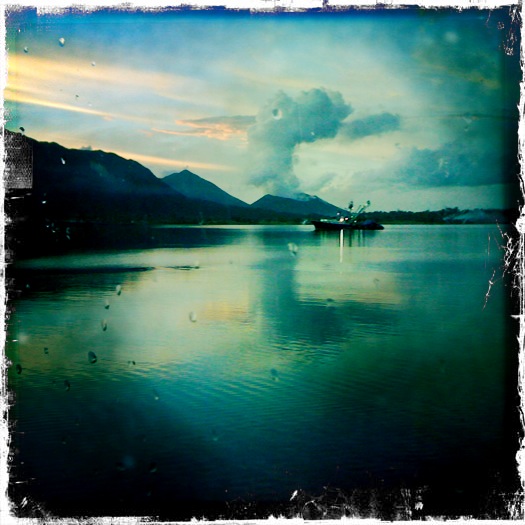
Around about 12:30 Orion berthed alongside the Rabaul wharf and we got our first view from Rabaul, across the caldera toward Mount Tavuvera.
A Hipstermatic shot by Kelly of the view to Mount Tavuvera

There are a couple of different options posted for today but Kelly and I have booked ourselves into the Volcano Tour. By 13:30 those going to the volcano are on the wharf ready to hop aboard a motley collection of vans.
Most of Rabaul, the capital of East New Britain at the time, was destroyed in 1994 by falling ash of a volcanic eruption. During the eruption, ash was sent thousands of metres into the air and the subsequent rain of ash caused 80% of the buildings in Rabaul to collapse. After the eruption the capital was moved to Kokopo, about 20 kilometres (12 mi) away. What’s left of Rabaul is still under constant threat from volcanic eruption.

We head out of the dock area and turn East on the Malaguna Road toward the area of Rabaul devastated by the eruption. Within minutes there are only the scattered remains of buildings and the road is flanked by high walls of grey ash.

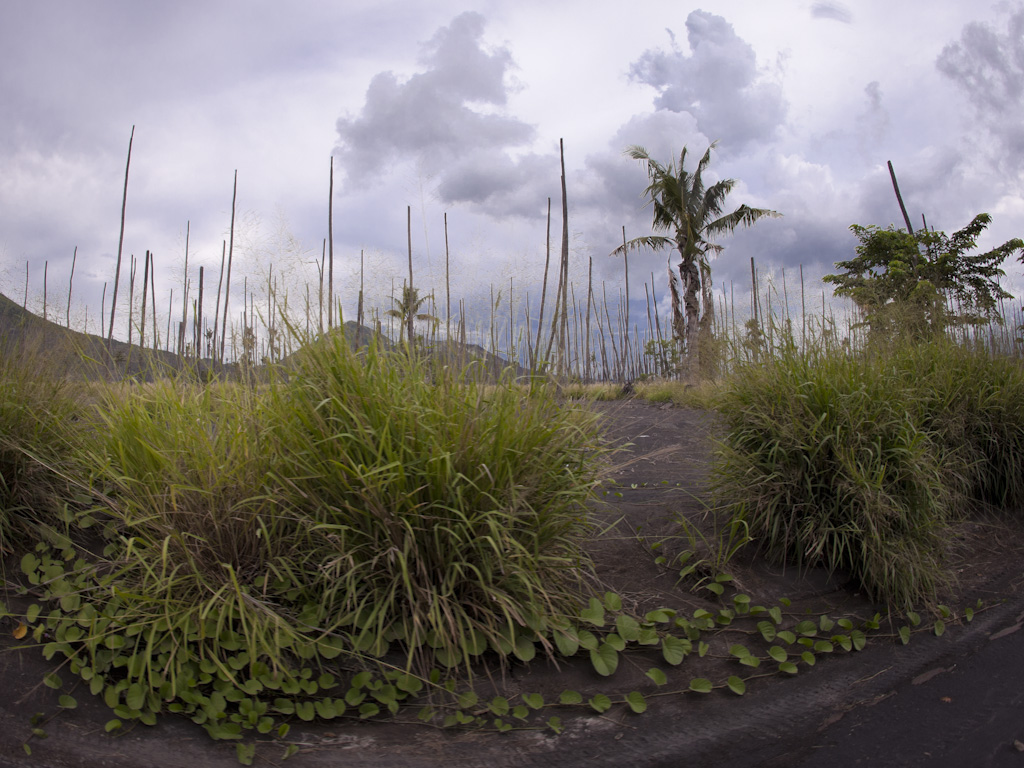
Peter Eastway, who’d been here not long after the eruption, expressed his amazement at how much some of the flora and fauna had recovered. His memory was one of a flat plane of grey ash, but now there are native plants populating the area.
Green plants surviving in the ash

Our drive took us right down to the end of a peninsula directly opposite Mt Tavuvera and after several kilometres we ended up in small village. I couldn’t believe that anyone would be living in the midst of this devastation and so close to an active volcano.

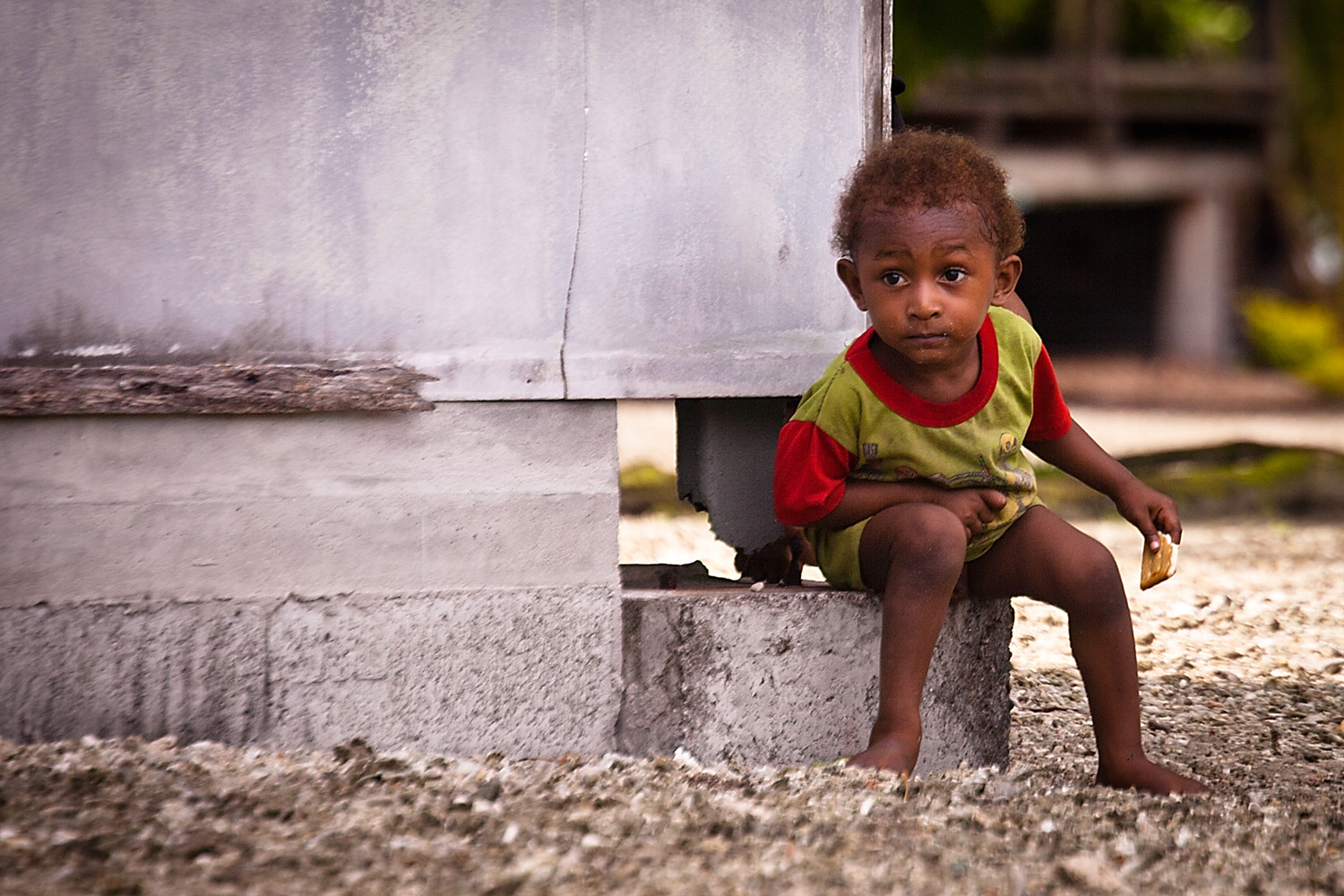
But there they were and as we walked down to the waters edge, through the village, everyone came out to greet us. The young boys all had amazing blond hair and seemed very happy to see us. I’m not quite sure though what this hand signal meant!
Young blond haired boy

Everywhere you could still see stark reminders of the destruction and havoc caused by the eruption. The palm trees have all had their tops sheered off or burnt off by the ash.
Burnt top of a palm tree with the rim of the volcano Rabalanakaia in the background

There were three boats with a crew of driver and guide on each one waiting to take us across the bay. With a bit of help from Mike, we managed to get on board and shove off from the shore.

Mick lending the locals a hand

Once we left the shore we headed across the bay toward the volcano.
Two of the three boats going to the Volcano

Unfortunately on our boat there was limited seating and poor old Peter, I’m not sure how he got the short straw, had to make do with crouching down in the keel of the boat.

Poor old Peter missed out on a seat

As we approached and area called Sulphur Point, south of the volcano itself, the stark reality of the place becomes more evident.

Frondless palm trees line the shore

We arrive at the beach and find ourselves walking on a sea of ash. Surprisingly though there are still some green living things to be found here.
Flowers in the ash

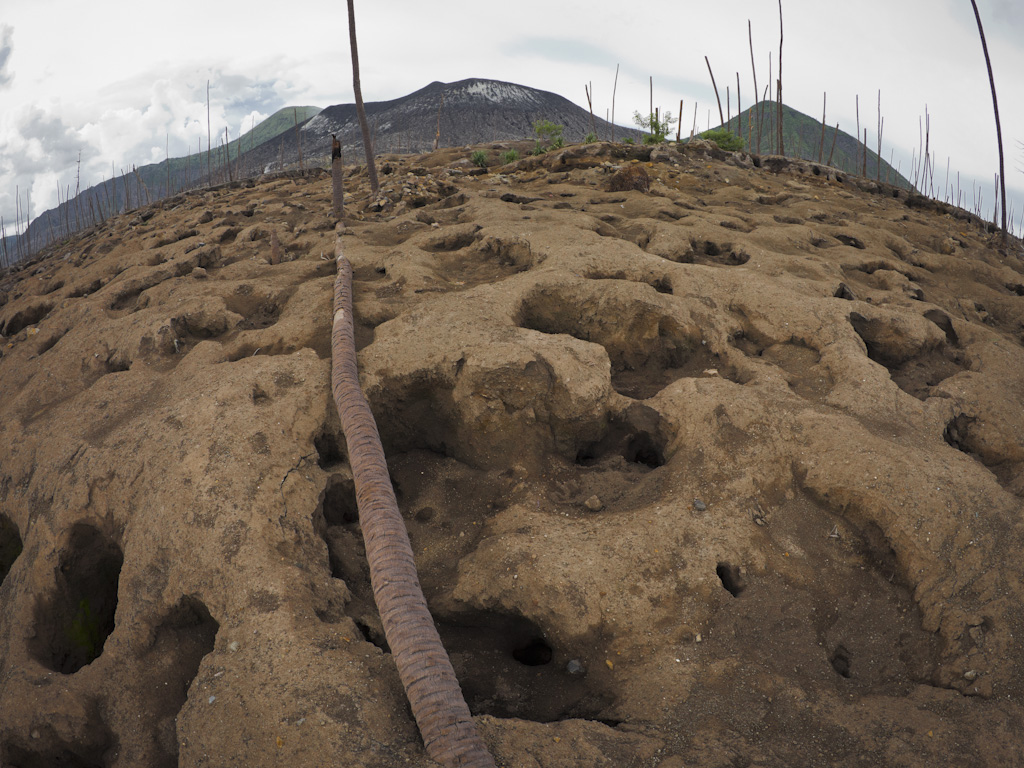
We didn’t see them during our trip, but at the base of the Tuvurvur Volcano the locals hunt for megapode eggs. The megapodes, also known as incubator birds or mound-builders, are stocky, medium-large chicken-like birds with small heads and large feet. The ground is littered with the holes dug by the natives and you need to be careful where you walk as the sides can collapse very easily as one of our party found out.
Megapod Bird holes

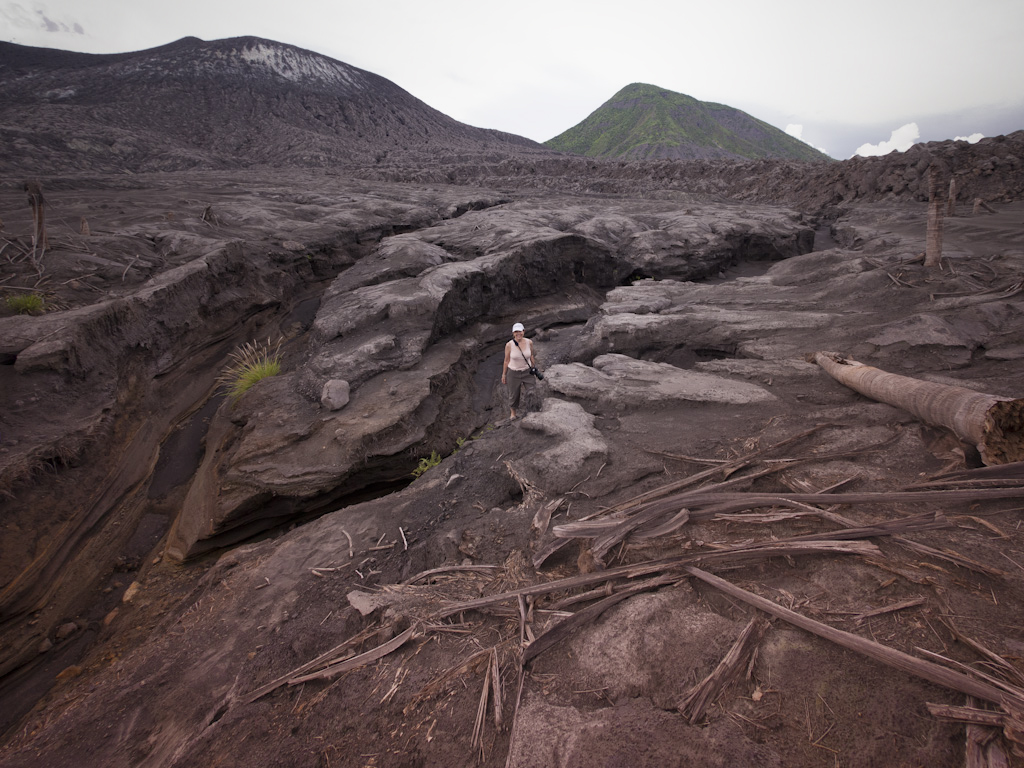
Pushing on further inland toward the volcano we came across these deep fissures in the ground that seemed to lead all the way from the volcano to the sea.
Fissures in the ground

The sheer scale of the mountain is very impressive and a bit overwhelming, in the back of your mind is a little voice saying, “this is an active volcano you are standing in front of and it could go off at any time”.
Kelly lost in the landscape

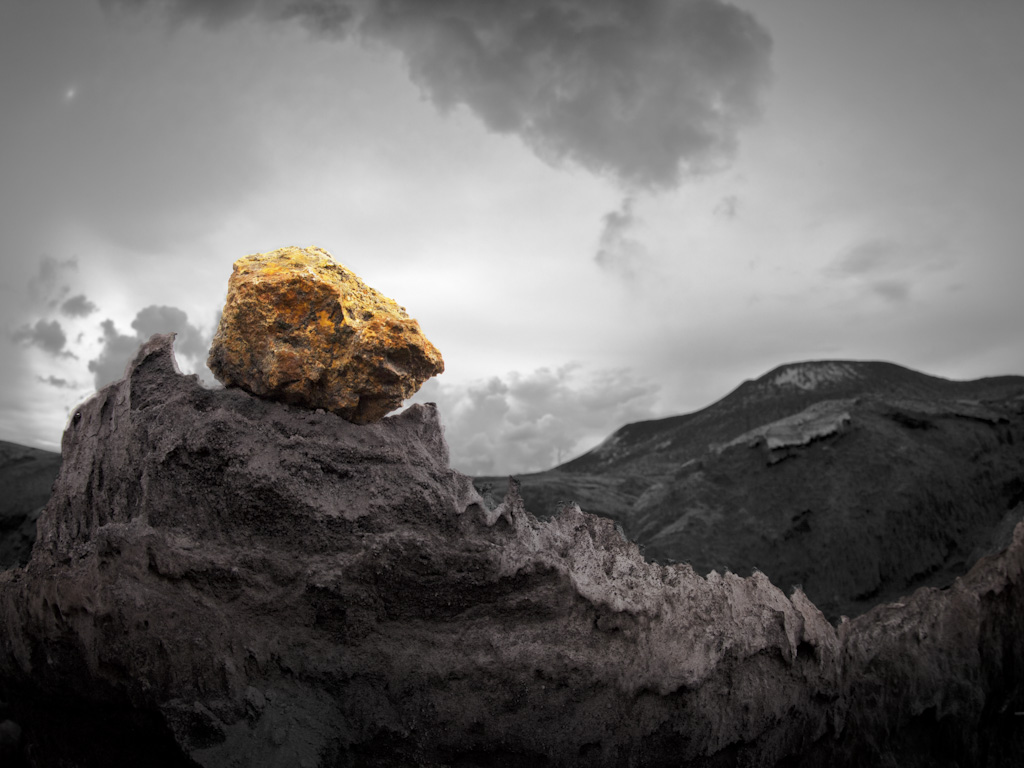
Just before we left I found this yellow rock that seemed to contain quite a bit of sulphur. Thinking back to some of the lectures by Peter and Nick I tried to create something a bit different and placed the rock on a jagged ledge and positioned myself looking up toward the rim of the volcano. The intention being to do some of the image manipulation Peter had shown us on it in Photoshop.
Sulphur rock

We got the call to head back to the boats to take us back to the village and then onto the ship.

When we got back to the ship there was a shuttle bus parked nearby. It was about 16:30 and they were scheduled to stop running at 17:00 so we approached one of them and asked if we could just get a quick tour around the town. The driver was happy to oblige so four of us jumped in and off we went.

Leaving the dock we headed down the main street past a large market area and through town. In fact our quick tour became a bit longer and we ended up at Mt. Tavanabatir the home of the Rabaul Volcanic Observatory. The observatory is perched high on the mountain above the town and provides a great overlook of Rabaul and Simpson Harbour.
View of Rabaul and caldera from the Observatory

Unfortunately this evening is the last of this leg of our tour and we will be saying farewell to all those great people we have shared this wonderful experience with. We have had the best time, learnt so much and enjoyed every minute of it.

Tomorrow morning those not continuing on the next leg, there are eight of us going on, will board the return charter flight from Cairns that is bringing in the next wave of quests.

So to finish off in style we had dinner in the Constellation Lounge with Nick, Gennine, Peter and Michael. It was lots of fun, and we were just a bit drunk at the end of it.

Tomorrow we will say goodbye to them and then shoot a number of 360˚ Panoramas of the cabins before the new guests arrive.
Day #11 New Guinea Adventure

At Sea

Today is another sea day, and once again that means no landfall but lots of onboard activities to keep us all busy.  Personally I’m looking for a bit of a relaxing day, with time to catch up on some much needed backups of my growing photo library and some book reading.

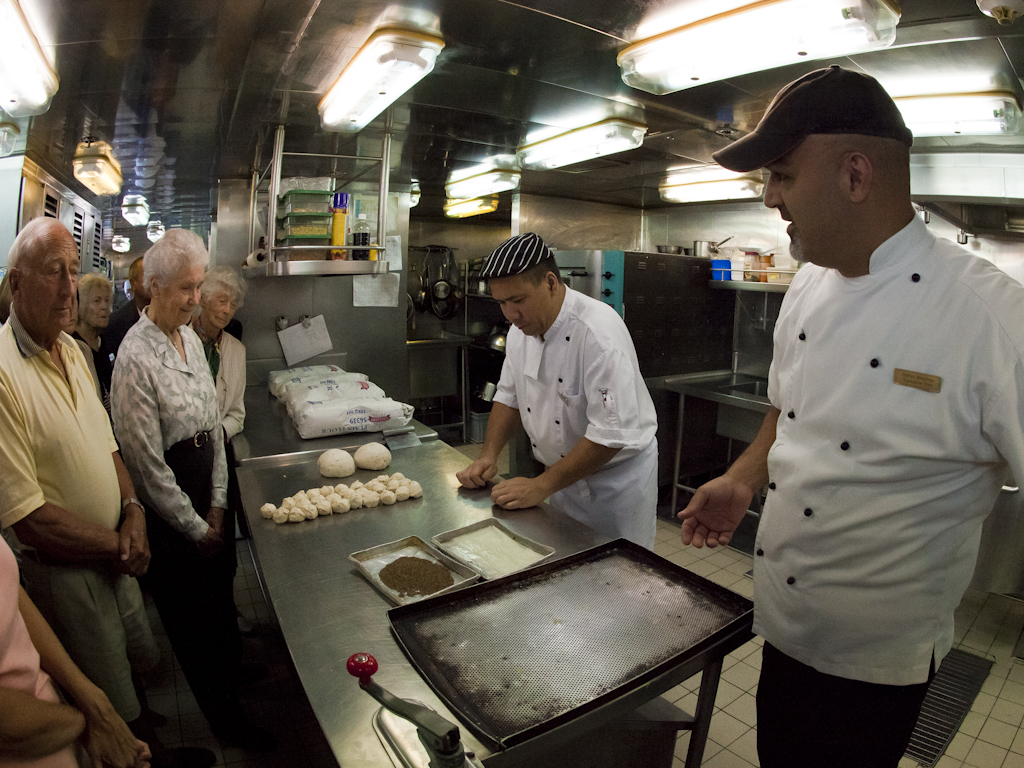
Executive Chef, Stefan Alverman shows us around the Galley

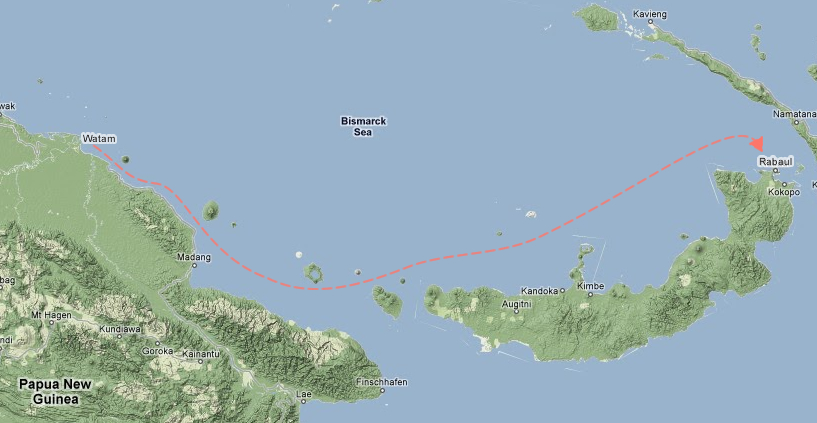
Our path today see us backtrack East with Rabaul as our final destination sometime tomorrow.


Map of the region showing our headingGoogle map link

After a leisurely breakfast we make our way to the Leda Lounge for a presentation by Mick Fogg, the expedition leader, on some of Orion’s future expeditions that will sail in 2011/12.

Mick’s presentation is fantastic and by the time he presents the Camp Leakey – Faces in the Forest – Voyage of Discovery, to be sailed in the new Orion II no less, I’m ready to sign up for it on the spot. It departs on December 29th and Mick is so passionate about it by the time he’s finished I’ve picked up a booking form and put our name down!

Here’s the information on the expedition from the Orion website, “A myriad of exciting destinations await us as we voyage along the southern and western coastlines of Borneo. From isolated tropical islands to diverse National Parks, our itinerary will showcase some of Borneo’s undiscovered jewels. We will be joined by Dr. Galdikas onboard Orion II and at the landmark Camp Leakey in Tanjung Puting National Park, allowing us the opportunity to view the rehabilitation of the ex-captive orangutans. Tanjung Puting is one of the great wonders of Borneo and is a wildlife mecca. We also visit Gunung Palung and Bako National Parks to examine, first hand, the complexity of ecosystems that once covered the entire Island. They now provide a refuge for Borneo’s 15,000 species of plants, 222 species of mammals, 420 resident birds, and numerous other reptile, amphibian and fish species.”

The Faces in the Forest itinerary

After the presentation it’s back to relaxing and we grab a bit of  sun time up on Deck 6. After lunch Justin is giving a presentation called “A Highlands Wedding: one man’s story” which, knowing him, should be very humorous.

At 2:00pm sharp we are back in the Leda Lounge for Justin’s presentation, anticipating a great talk, and we are not disappointed. 
His presentation was an in-depth, personal journey through the marriage proposal process entering traditional Papua New Guinea society. It covered more than 10 of his years in PNG, including marriage to a highlands woman, two highland wedding feasts and an axe-wielding father-in-law!
A young Justin in his new village house [from Orion Expeditions] - For some amazing stories follow Justin as he travells the remote spots of the world on his blog, Global Citizen

Wow these sea days are tough, now we have to go up to the sun deck as they are serving “devious” ice cream sundaes…tough.

After the sundaes, which were indeed devious, we head on down to the Library to meet Stefan, the Executive Chef, who’s going to give us a guided tour of the Galley.

It’s great to see behind the scenes, it’s amazing how they can accomplish so much in such a small confined space. Stefan gives us a great overview of the kitchen and points out each of the prep stations that are manned almost every hour of the day.

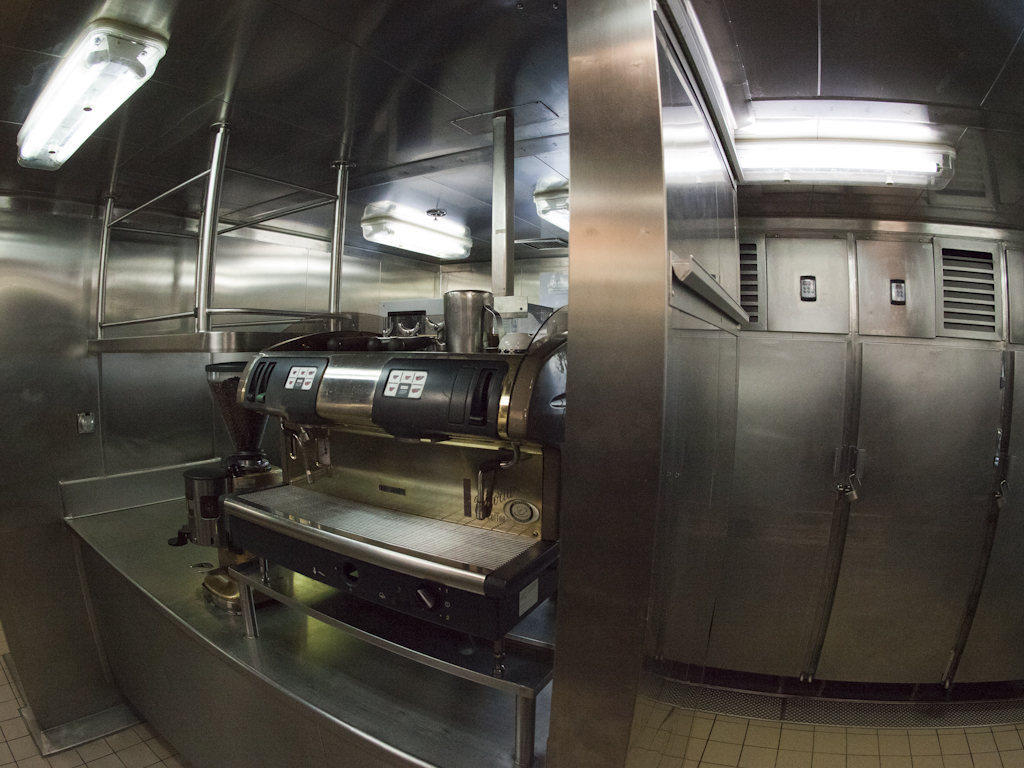
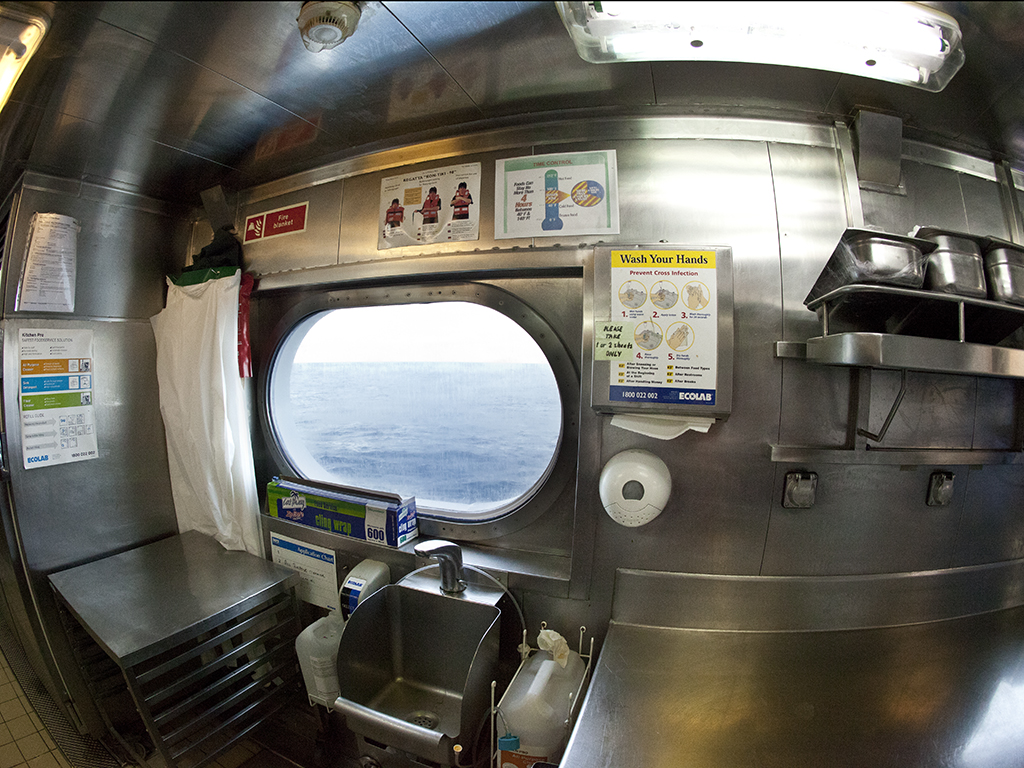
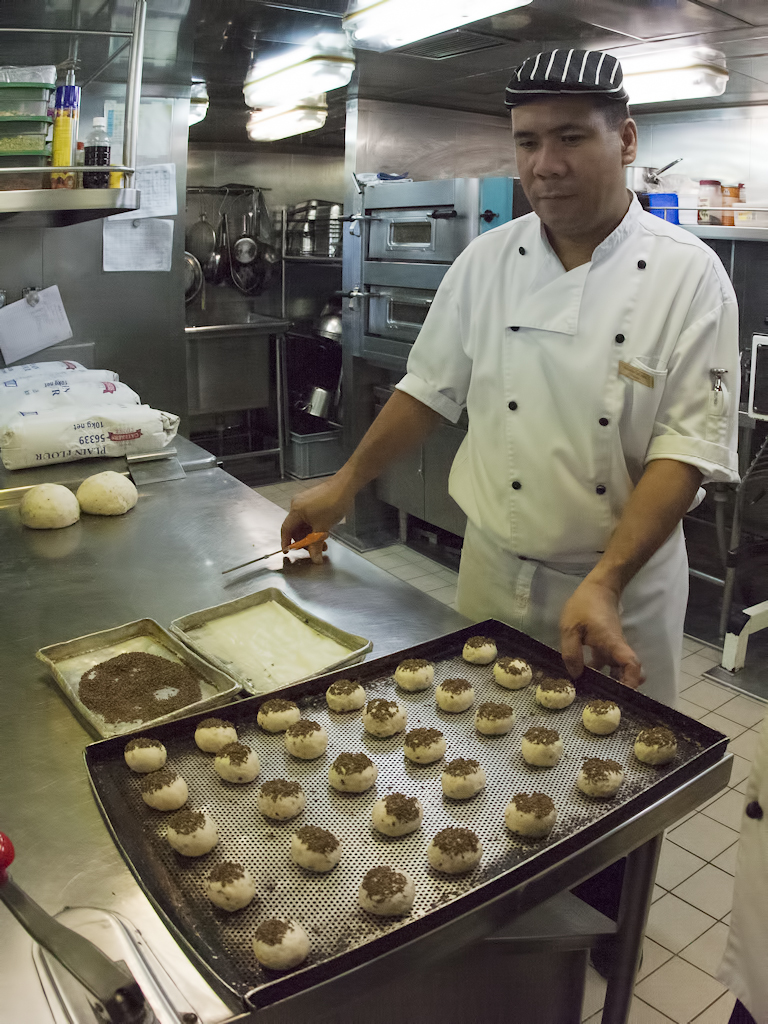
Sample of images from the Galley: Expresso Machine, Dishwasher, Work Station, Cookies ready for the Oven

So much for lazing around, after the Galley tour we head up to the Cosmos Theatre for a lecture by Mick entitled, “In Vulcan’s Shadow: The History of the Rabaul Caldera”. Mick takes us through the formation of the Rabaul Caldera as well as the volcanic and significant history of the Rabaul region.

I’ve never been close to an active volcano before and I can’t wait to see Rabaul and experience it up close. For more information on Rabaul check out the Wikipedia entry.

There’s one last event for the day and that’s a recap by the expedition team on our day at the Watam village and the Sepik River and a briefing on our day in Rabaul tomorrow.

Dinners in the Constellation restaurant so Kelly and I decide to head for the cabin and a bit of room service.

So much for a lazy day!


Day #10 New Guinea Adventure

Watam Village/Sepik River, Papua New Guinea

We wake to find ourselves in Broken Water Bay just south of the mouth of the Sepik River. There’s quite a large rolling swell going on and the ship’s stabilisers are working to keep us from swaying too much.
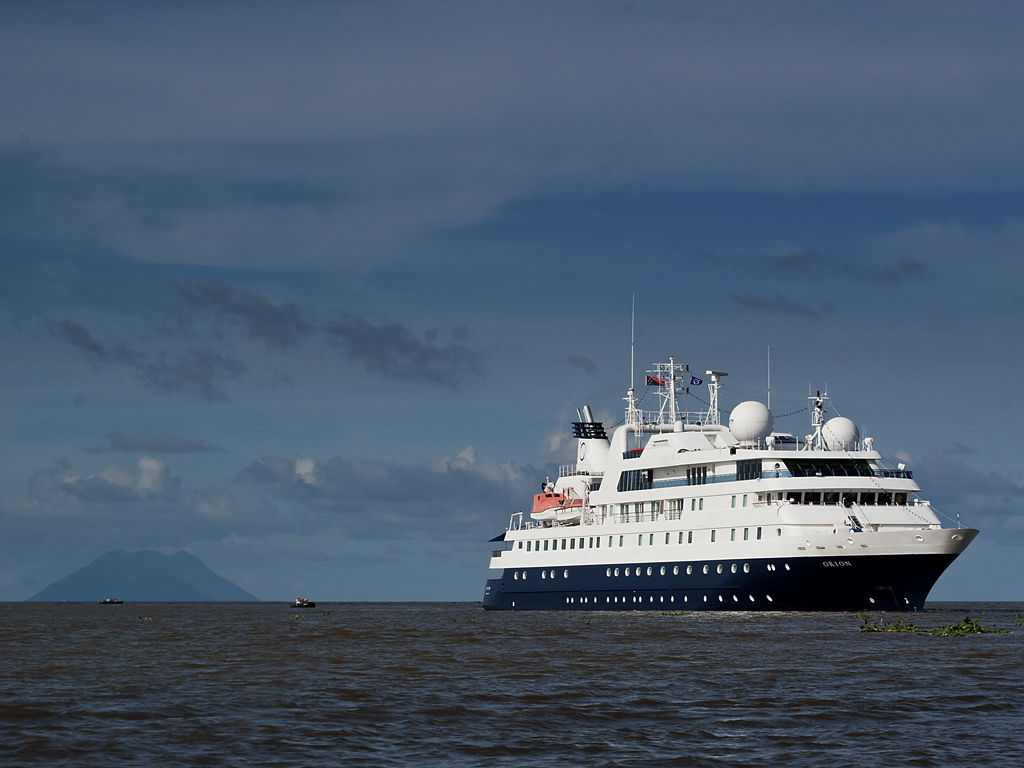
Orion anchored at the mouth of the Sepik River with the island of Bam in the distance

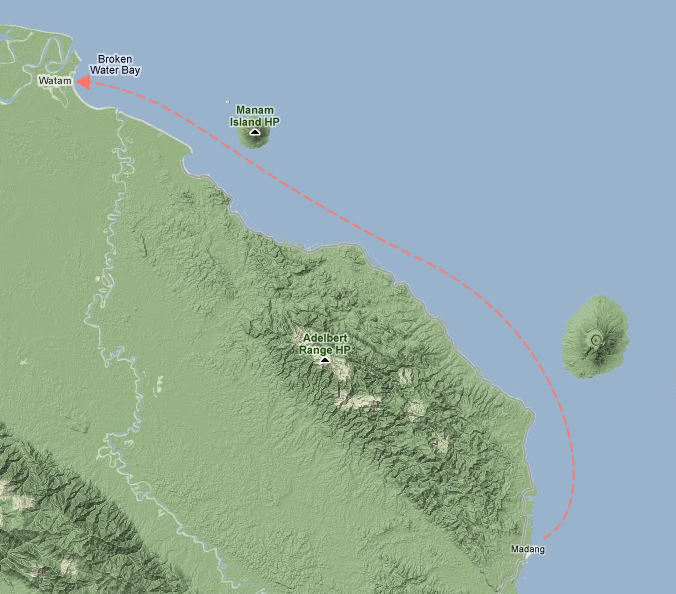
Last night’s sailing from Madang has taken us past some of the most active volcanoes in Papua New Guinea and in the distance we can see the Island of Bam. Bam is located 37km northeast of the mouth and is the conical summit of one of western Papua New Guineas most active volcanoes, with the most recent eruption taking place in 1960.
Map of the region showing our headingGoogle map link

The Sepik region is an immense grassland reserve, surrounded-d by one of the world’s greatest rivers which runs 1,126 kilometres from the mountains to the sea. The history of the Sepik region reflects the influence over the years of the missionaries, traders, labour recruiters and administrators. Parts of the Highlands remain untouched just as they were when first discovered in 1933. In fact some villages have yet to see a white man.

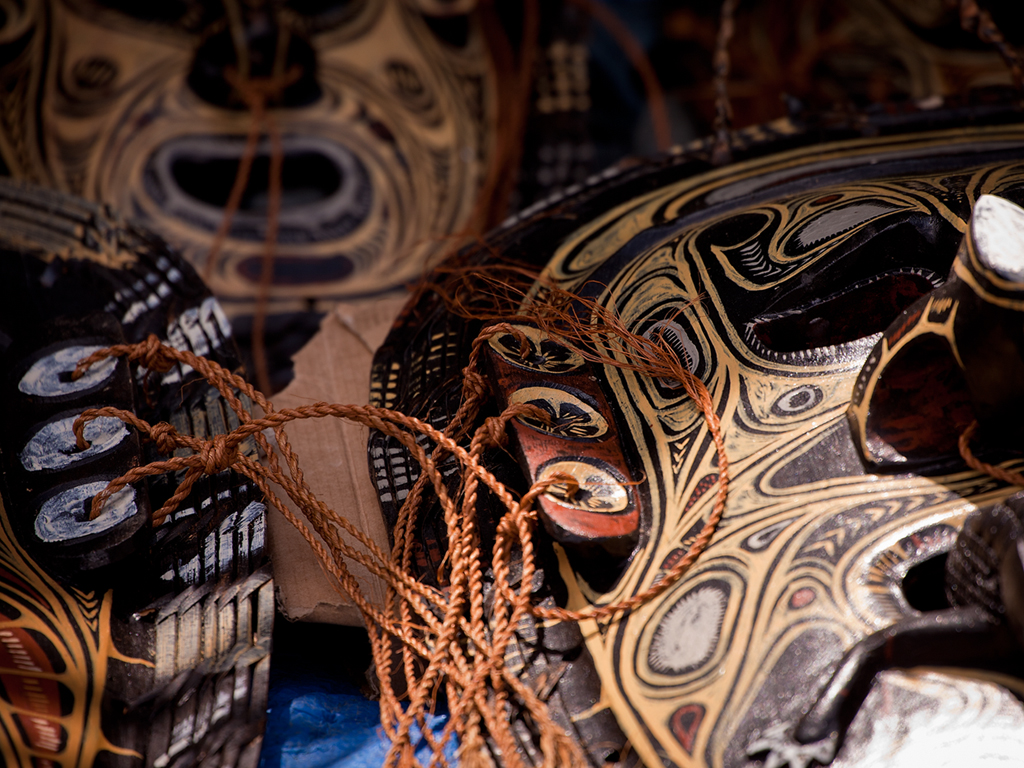
The Sepik River has long been world famous for the quantity and quality of its wood carvings and for the imposing architecture of its Haus Tambarans – Spirit Houses. Spirit Houses were lined with shields decorated with the faces of ancestors, whose likenesses appear also on the masks.
Shield masks on sale in Watam

The first expedition today, after breakfast that is, will be to the village of Watam. So Kelly and I head off to breakfast negotiating the corridors and walking in time with the swell.

We’d only been on the back deck for a few minutes, Kelly had her breakfast and was looking for a table, I was just getting some cereal, when the ship really started swaying from side to side.

In a second it was mayhem, tables and chairs, with people in them starting sliding on the steep deck, plates were falling off tables and smashing on the deck. From where I stood there was a small gas fired hotplate on my left hand side and large bowls of yoghurt and fruit to my right. Trying to keep my balance I kept and eye out on each side to avoid being burnt by a flying hotplate or slimed by the yoghurt!

After a minute or two Captain Frank made the decision to up anchor and move to a more settled spot to reduce the sway but by that time the damage had been done. Later we found out that most of the glasses in the bar had been damaged but fortunately no one onboard had suffered any injuries. We were especially concerned for the guys in the galley as that must have been a dangerous spot to ride this out.

Our first disembarkation starts at 08:30 this morning and everyone will be disembarking at the same time. It will be a wet landing at the village and we need to stay as a group as the welcome will only start when we are all together.

Justin Friend, is an honorary chief of the village, having been crowned so in 2008. There’s an article and pictures on the occasion in the NZ Herald. Justin gave us the low down on what would happen. After we land there is a processing into the village led by a ceremonial dragon, we need to follow behind this procession and wait until the ceremony is finished before moving out into the village itself.

Our fleet of zodiacs head toward the shore and there’s a bit of manoeuvring to get past a line of waves breaking off the shore, in the distance we can see a low lying boat filled with locals.
Welcome boat

As we get closer they are singing and welcoming us to their home. I hope that the boat doesn’t sink as there are lots of people singing and moving about in what is a pretty small boat.
Dancers and singers on the boat

Once ashore we form a group and follow the ceremonial dragon and dancers up into the village.

Head of the Ceremonial Dragon

It’s another hot sunny day and the village looks beautiful. The village is built on a large flat area of ground with a very wide promenade through the centre of it. On each side are the Spirit Houses and other village houses and lining it are ornamental poles made from local plants.
Ornamental Poles

Once again the dancing, singing and costumes of the villagers are spectacular and we follow along as they move further and further into the village. The age of those in the ceremony varies from the young to the old.
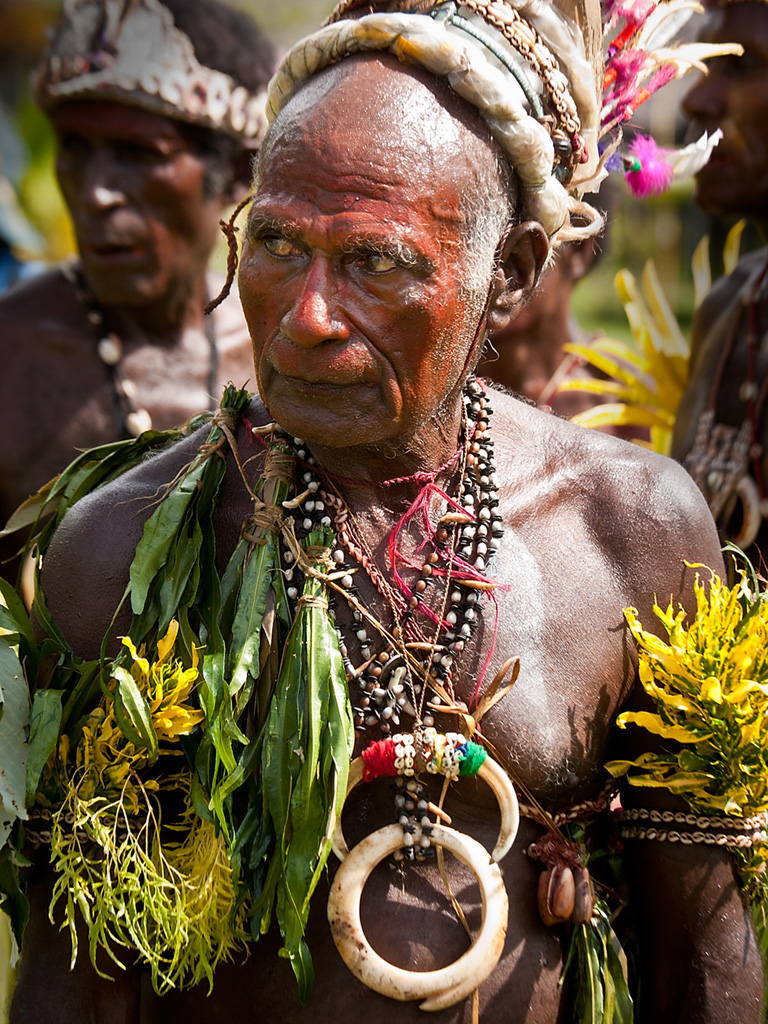
Old warrior

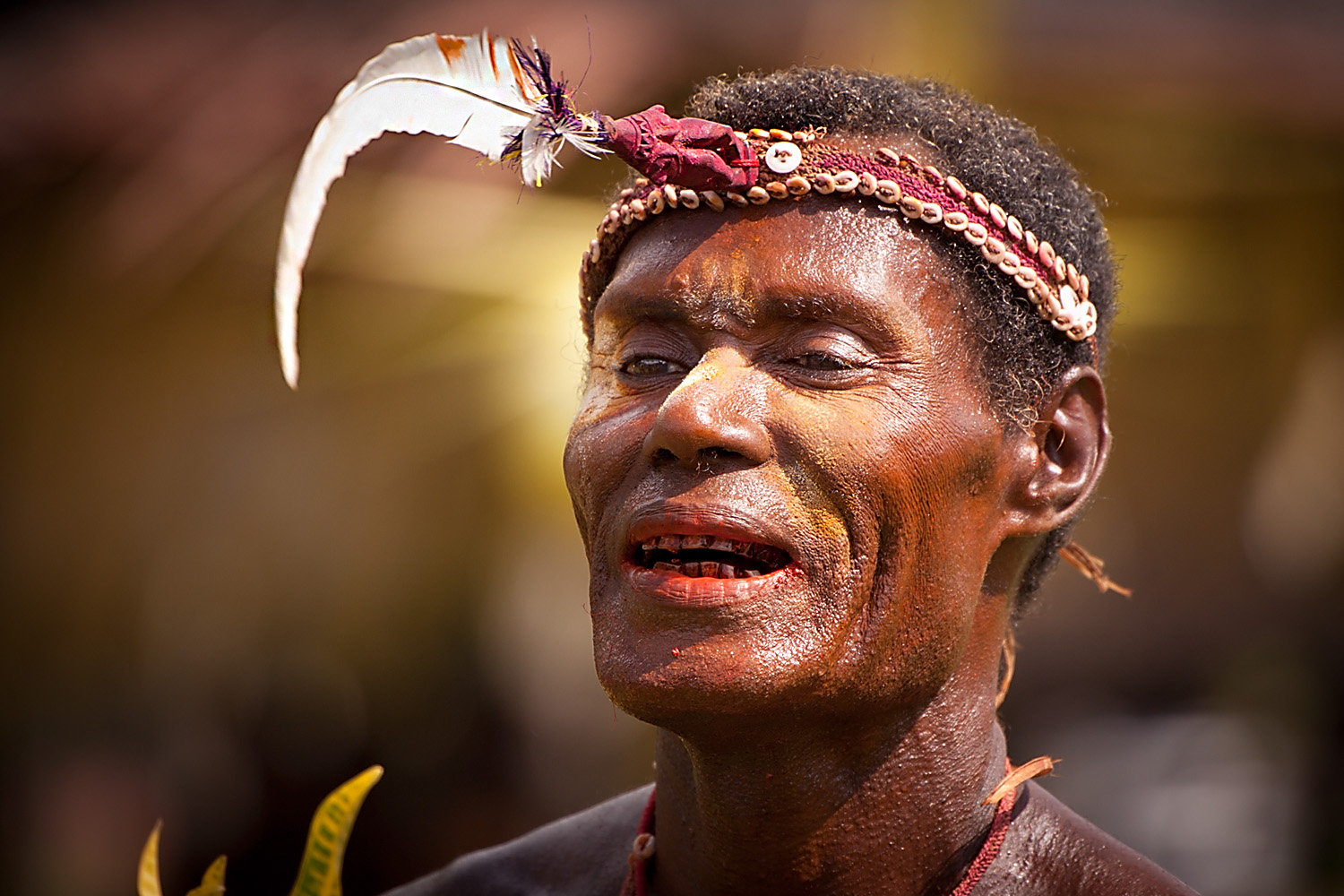
No matter the age they are all dressed in magnificent costumes of feathers, shells, and leaves.
Dancer with feather headdress

Even the kids are dressed up.
Young girl taking part in the ceremony

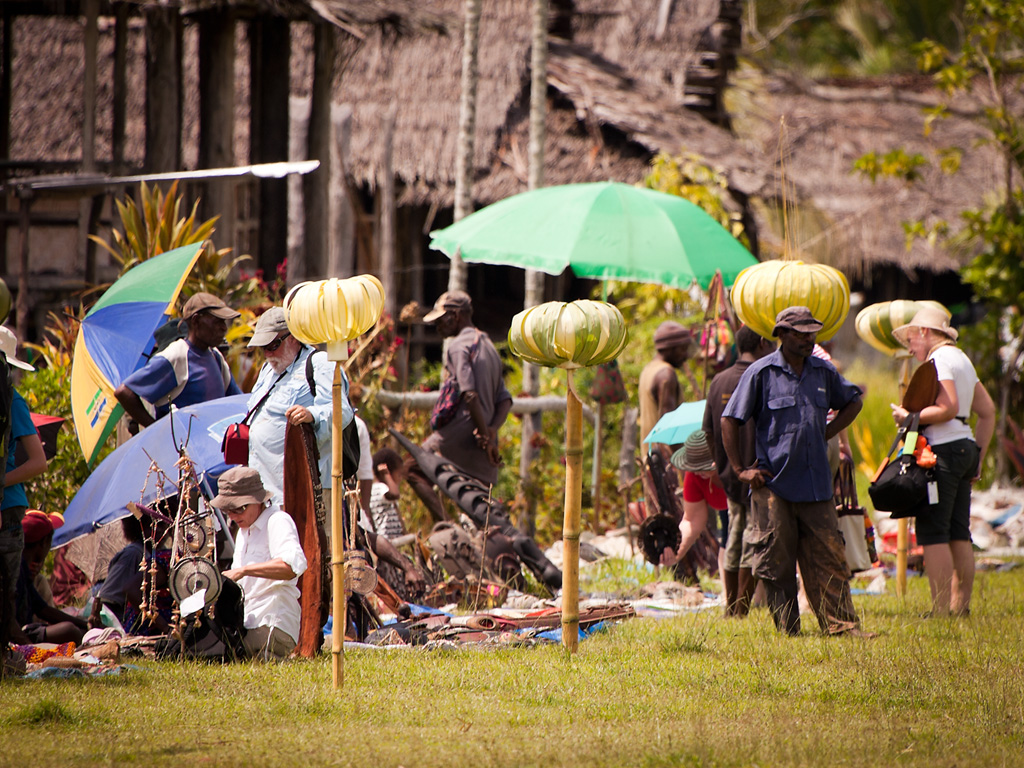
After the ceremony we are free to walk around the village, meet the locals and view the artefacts they have for sale. One side of the entire length of the promenade is full of beautiful carvings, bags, shields, masks and many other bits and pieces layer out on rugs or hanging off rustic fences.
Selling artefacts

We had a great time in the village, we met and talked to a number of villagers, walked around and had a good look at the houses they had built.
Typical village house

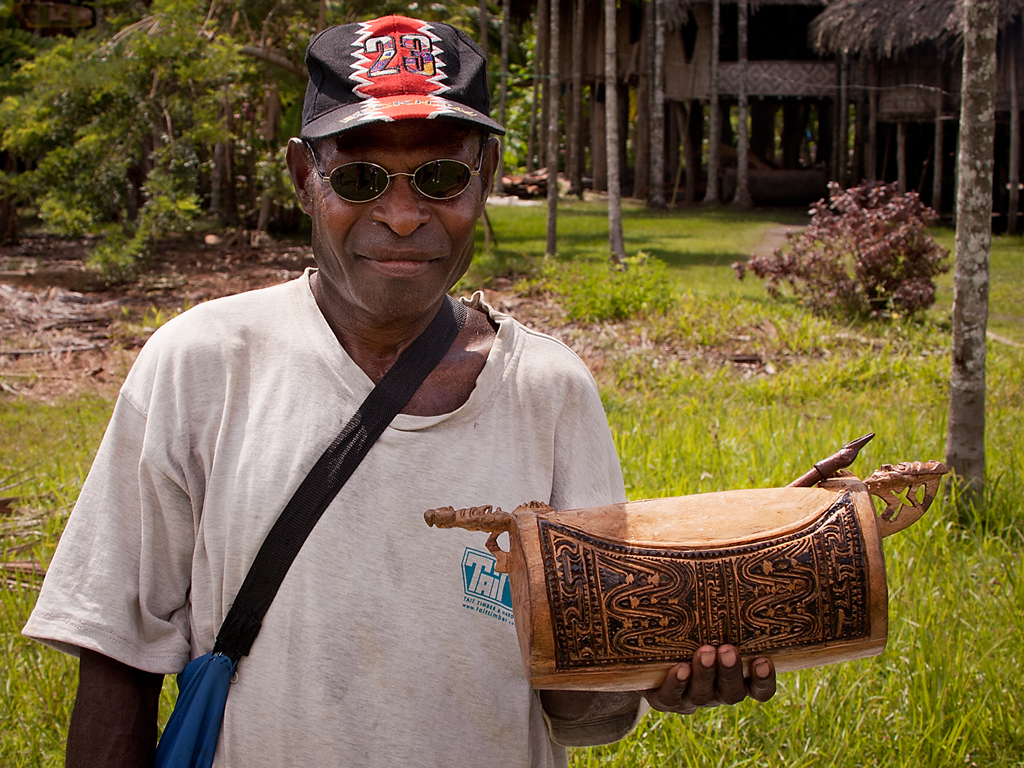
Of course we did some shopping and purchased a number of items made in the village including this intricately carved wooden drum.
Carver with our drum

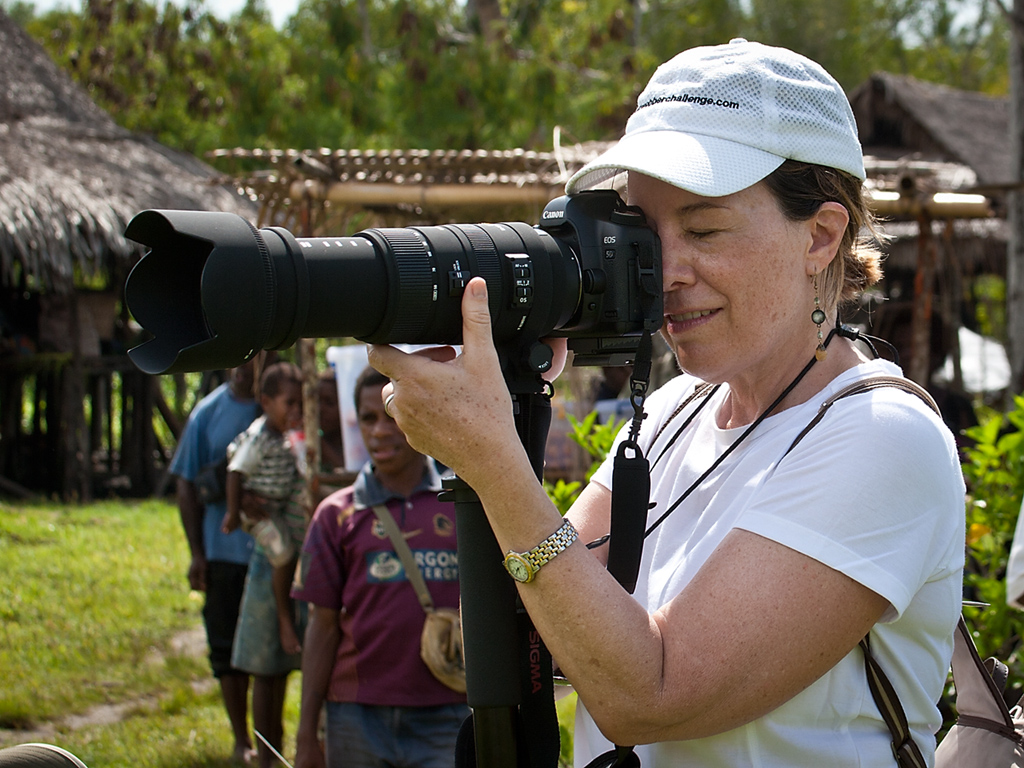
It was a great opportunity to shoot some photos and Kelly had borrowed the 5D and the 50-500mm lens to try it out.
Kelly shooting with the big lens

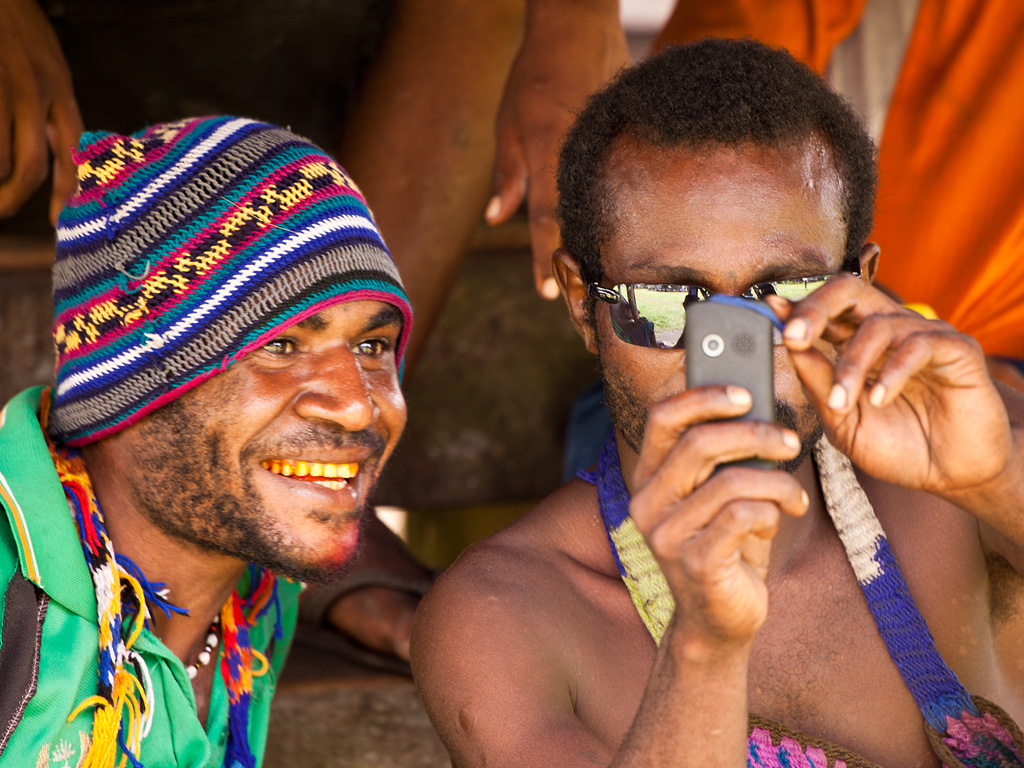
Now it wasn’t only us shooting pictures of the village and villagers but at one of the men’s houses they were just as interested in taking pictures of us as we were of them.
Here we are on the other side of the lens

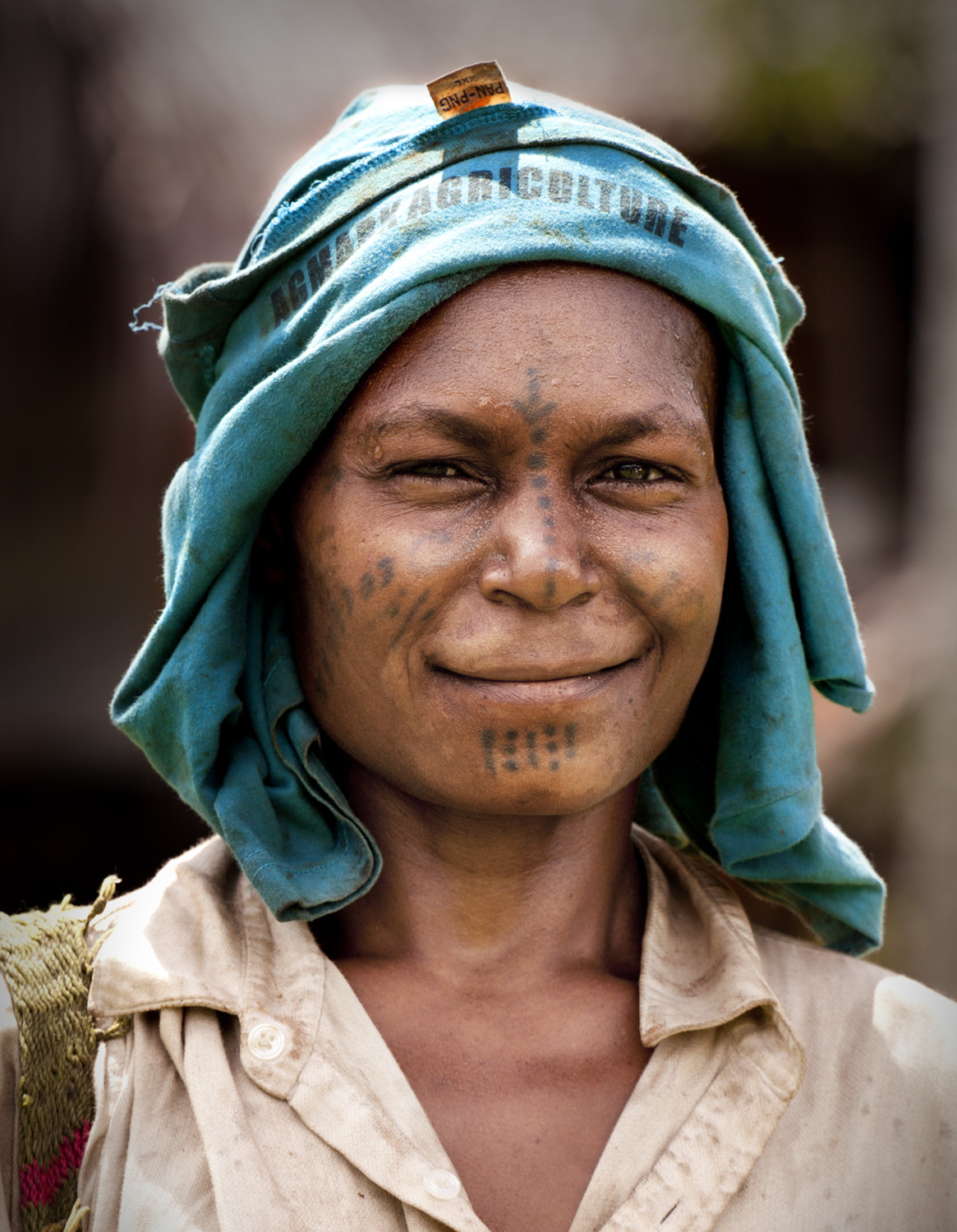
Stopping by the stalls gave us the chance to meet and talk to those selling items and they were very friendly and happy that we would visit them. Some of the women had beautiful tattoos on their faces.
Young woman with t-shirt hat

Everyone we met were happy to have their photographs taken, once we’d asked them and loved to pose for shots.


Older women with flower umbrella

When buying some of these artefacts especially the wooden ones you need to be careful that there are no borer holes in the wood. If there are you run the risk that Australian customs may require the object to be fumigated upon your arrival back into Darwin. Fortunately we had Mick Fogg on hand to give our objects his trained inspection.
Mick checking for borers in a sculpture

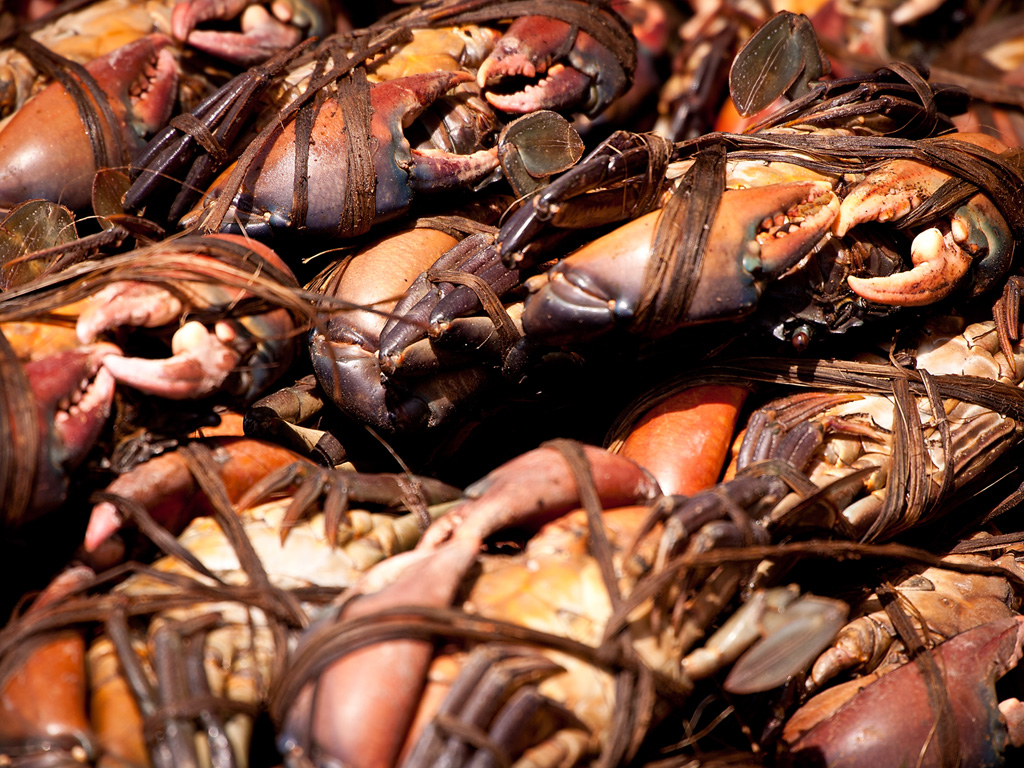
Just before it was time to head out I saw the Orion chef walking up through the village. The villagers were wrapping hundreds of freshly caught crabs in string pulled from local plants and he was going to buy the majority of them for a BBQ on board Orion this evening.
Freshly caught crabs

All too soon it was time to return to the Orion for lunch and we all headed for the beach saying our farewells to the villagers before boarding the Zodiacs. Once we were all on board Captain Frank up the anchor and relocated Orion in the mouth of the Sepik River. As the Sepik River has no delta the water comes rushing down to the sea and stains the sea brown for up to 50 kilometres. So even though we are anchored, when you look over the side the water is rushing by so fast it feels like you are still moving.

At 13:30 the first of the Sepik river expeditions left, we waited until the second one at 15:00 to give us a bit of down time between the village and the river.
We made sure we arranged it so that we would be in Mike Moore’s zodiac as he’s so knowledgeable about the area especially the bird life.
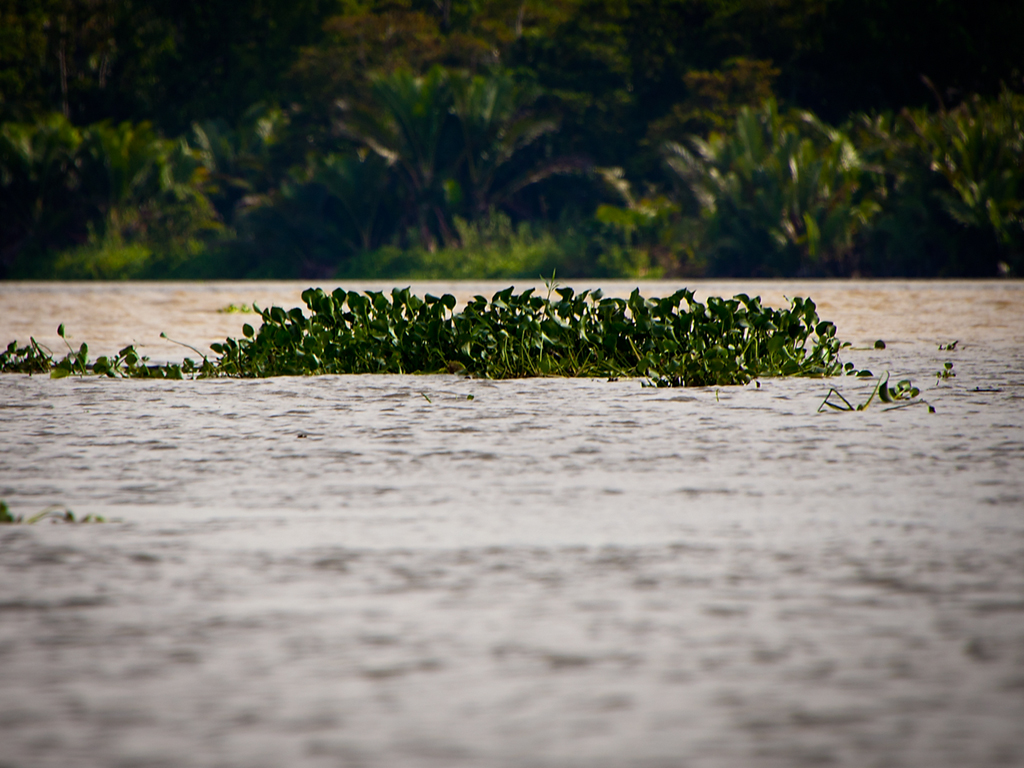
We head off upstream against the rapid flow of the river. The first thing you notice is the large amount of vegetation flowing down the river. There are huge islands of water hyacinths.
Clumps of hyacinths floating downstream

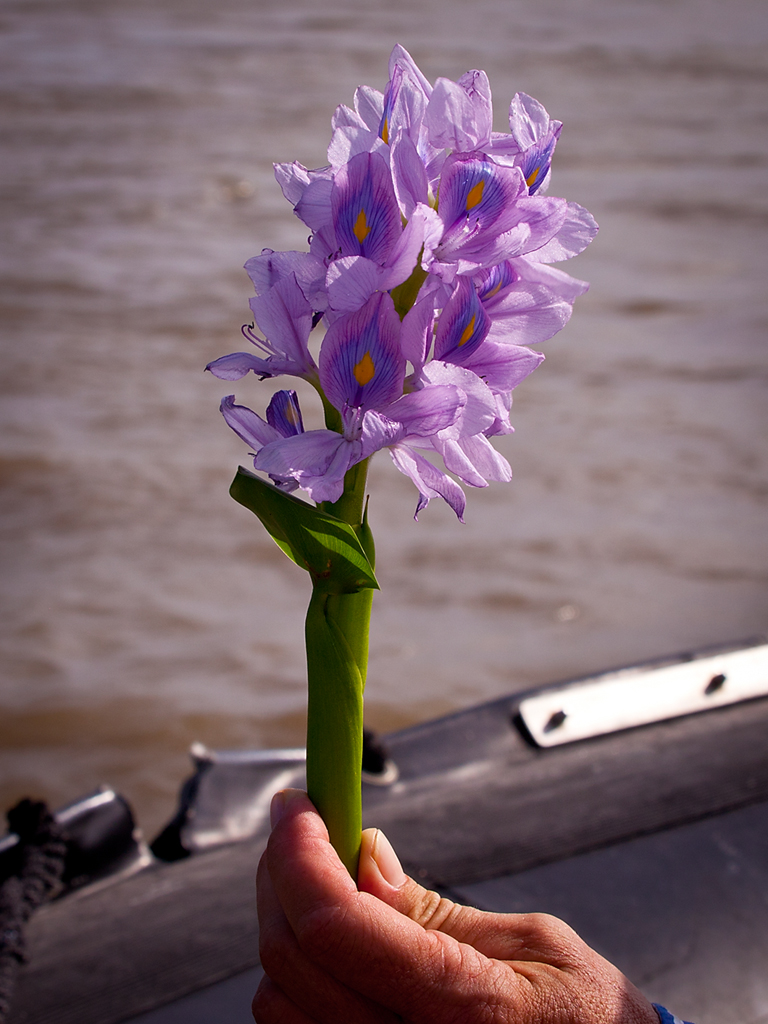
Its dramatic blue flowers and shiny green leaves make it highly prized as an ornamental plant. However its beauty is deceptive. Wherever it has been introduced, particularly into tropical climates, the plant spreads so rapidly that it is now regarded as the world's worst aquatic weed.
Hyacinth flower plucked from the river

The introduction of water hyacinth into PNG more than thirty years ago, has had drastic results. It now grows prolifically in more than 200 locations throughout the country, clogging many of PNG's most important waterways. Its impact disrupts human activities and threatens entire ecosystems. In some areas such as the Sepik River region, its growth has had a huge impact on the health and activities of the local people. Yet people continue to collect and grow it as an ornamental plant.

Another interesting fact about the Sepik River, due to its age and changing course, is that there are no stones or rocks within 50km of the river’s banks. Villages have ‘sacred stones’ that have been carried in from far away and placed in front of village Spirit Houses.

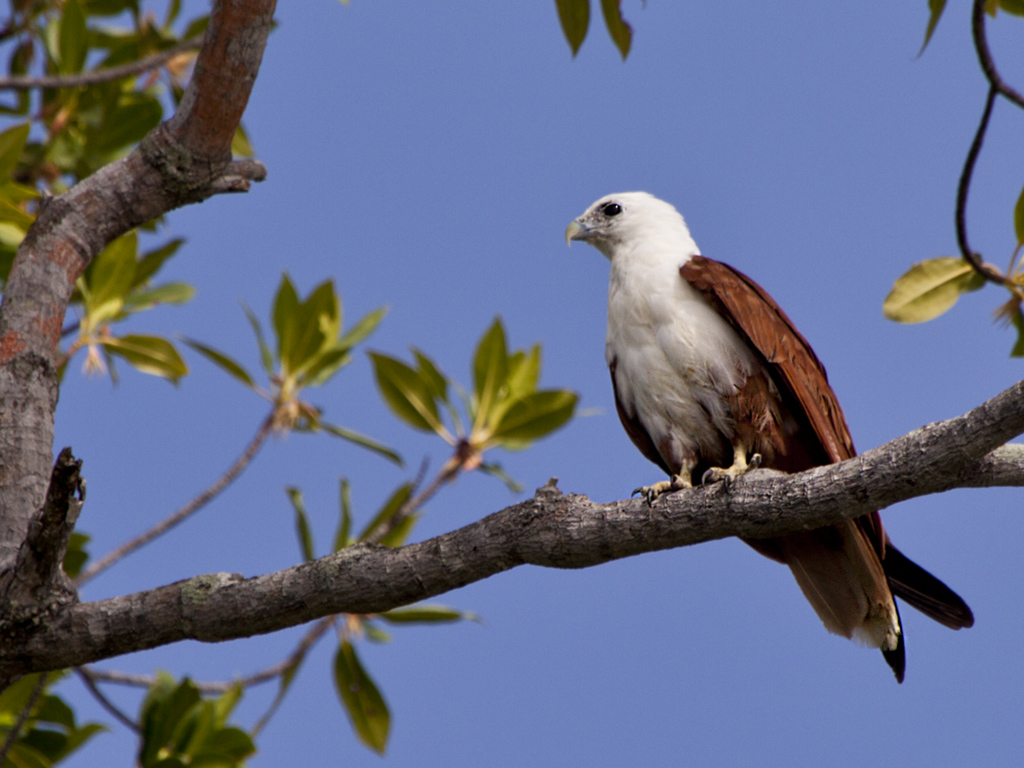
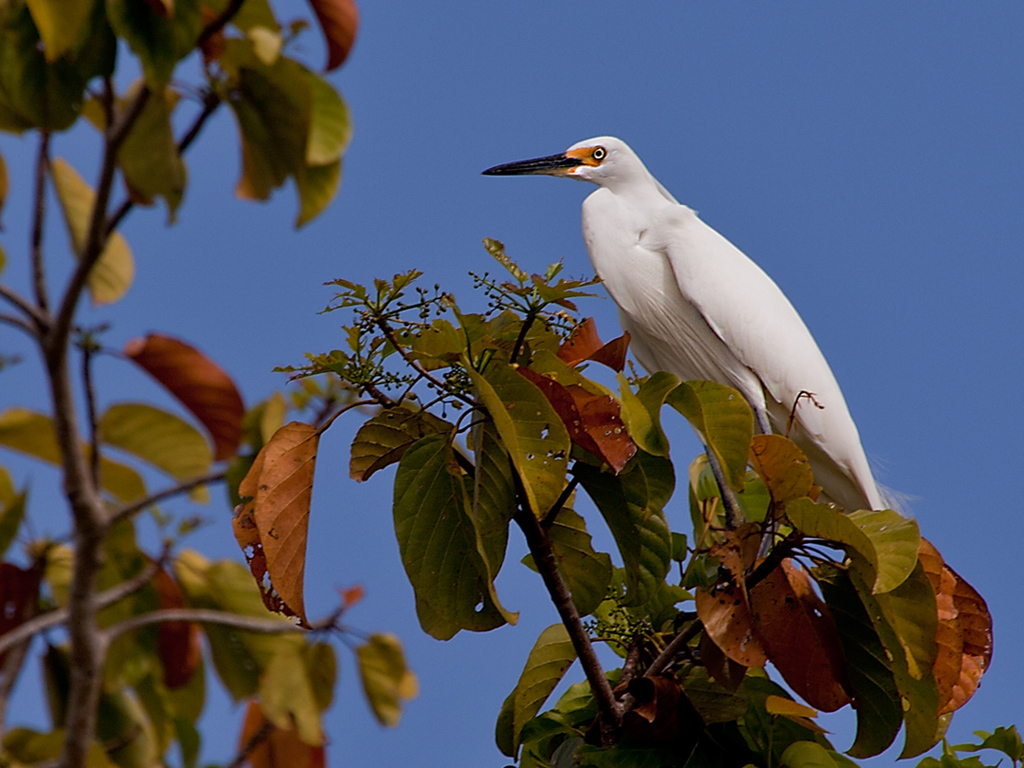
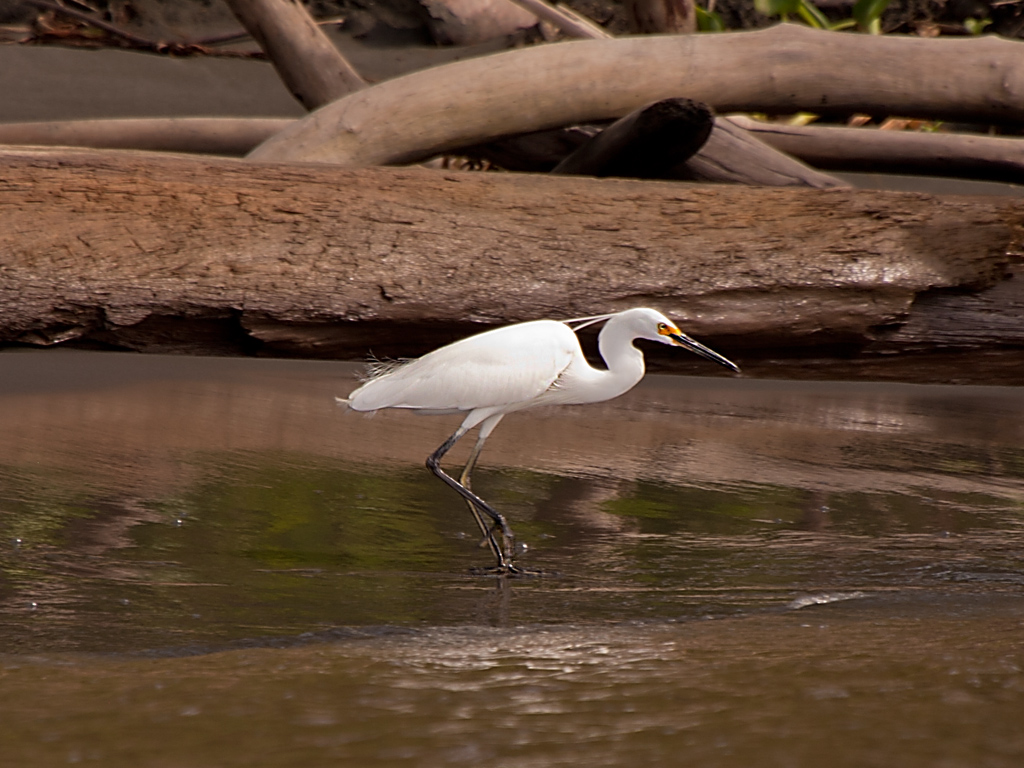
As we head further up river we see a number of bird species, unfortunately I can’t remember the names of them so if anyone wants to comment I’d appreciate it. I’ll see if I can send them to Mike to identify. I think the first one might be a Harpy Eagle.
Harpy Eagle
Bird 2 in a tree
Same as Bird2 but by the waters edge

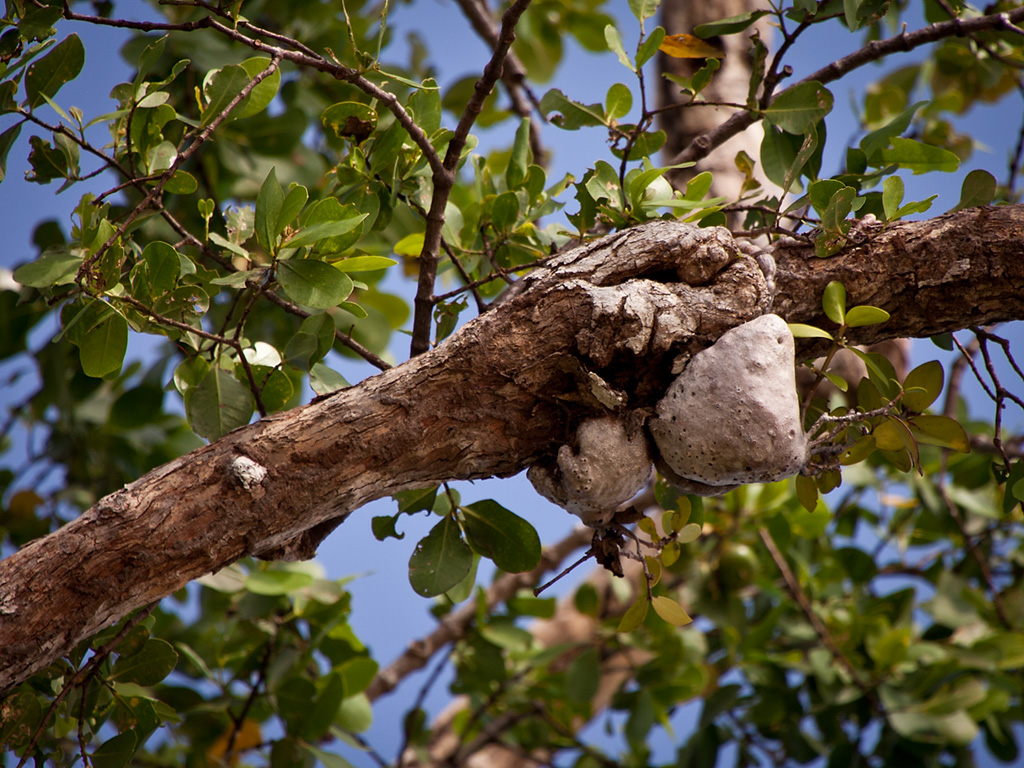
Mick also pointed out in the trees you could see these strange bulbous shapes (caudex) hanging off branches. He told us that they are the homes for ants! Apparently these ants climb the trees and form a symbiotic relationship with the tree.

The Ant plants provide habitats for ant colonies high up into the forest canopy, protecting them from the elements and also predators because of the spines. Hollow, smooth-walled tunnels form within the caudex with external entrance holes, providing an above-ground home for ant colonies. Ants likewise provide defence for the plant and prevent tissue damage, swarming to defend their home if disturbed. Ant colonies also provide nutrients to the plants by leaving wastes within the tunnels inside the caudex. Special glands lining the tunnels then absorb nutriment for the plant. This symbiosis allows the plants to effectively gather nutrients (via the ants) from a much larger area than the roots ever could cover.
Caudex on an Ant Tree

At a certain point it was time to turn around and head back down the river toward it’s mouth and back to Orion. To this point the rivers edge we had been navigating near had been completely wild with the jungle growing right to the edge.

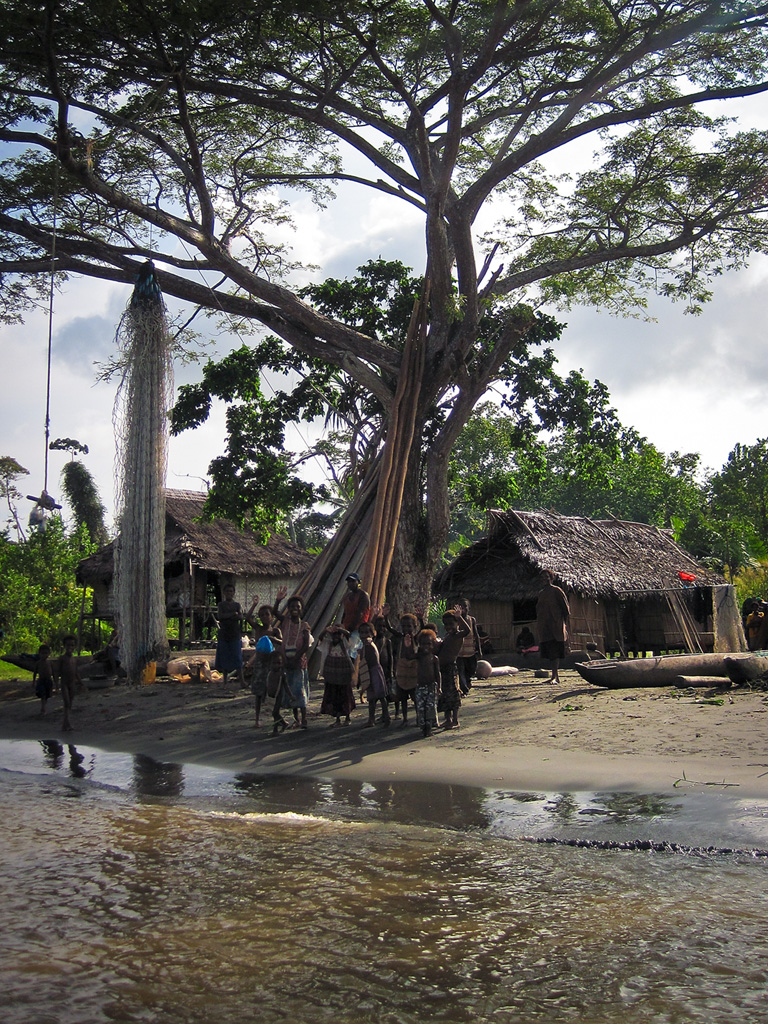
As we turned to head home we moved toward the far bank where we could see the huts of villages lining the shore.
Sepik river village

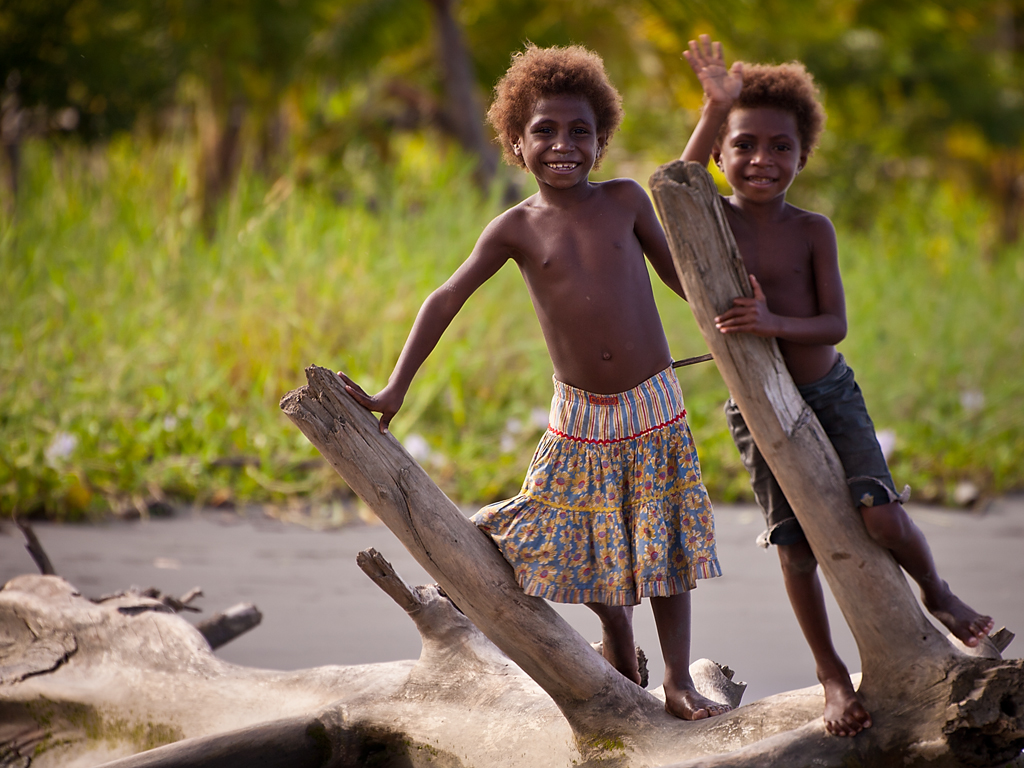
As we motored past there were lots of children running along waving to us, excited as we were to see them they were to see us.
Two kids playing on a log in the river

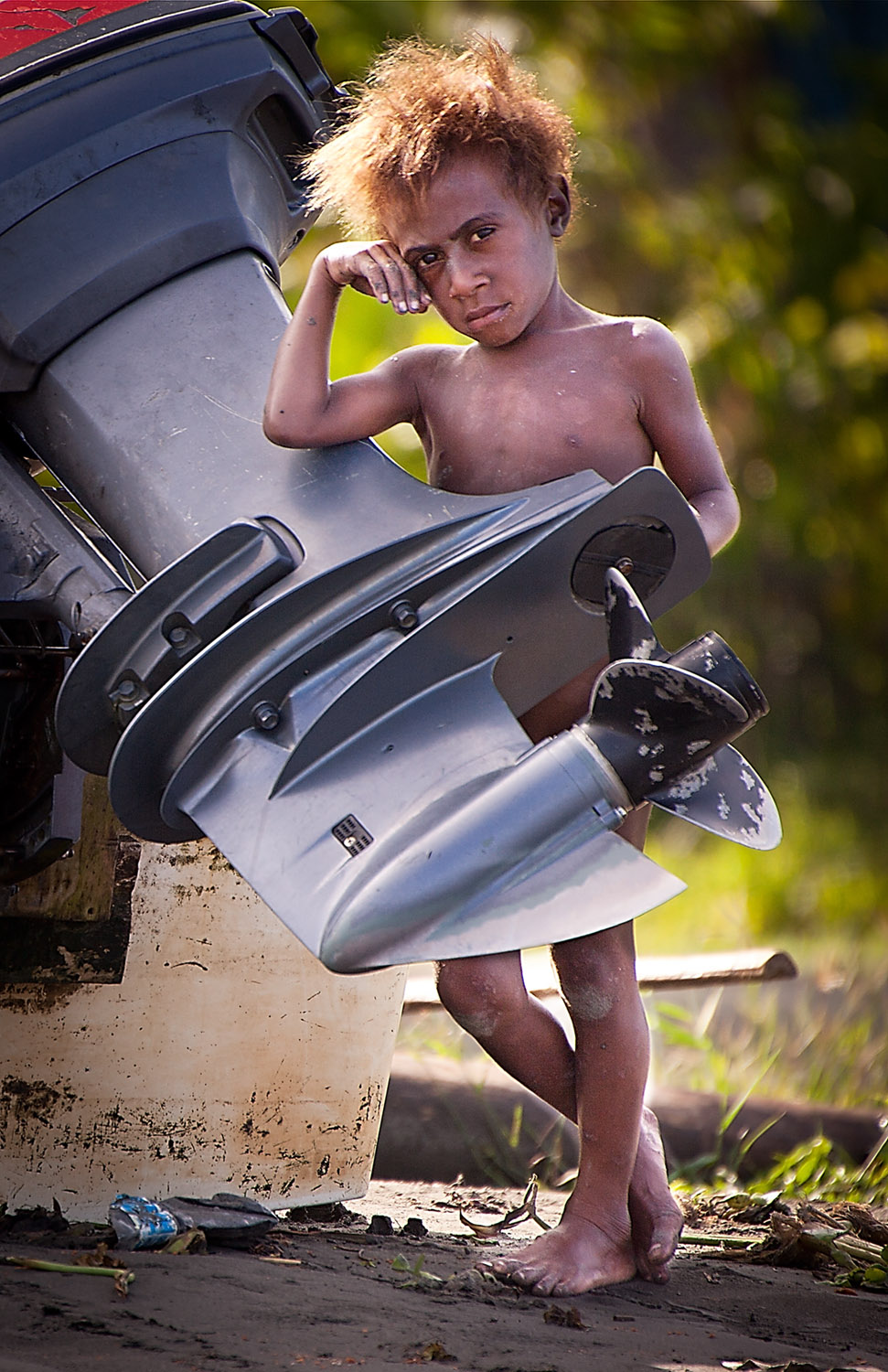
It was interesting to see that the villages had motorised water transport along with the traditional dugout canoes.
Young girl leaning on the outboard motor

Back on Orion it was time to chill with a cold beer, hop in the tub for a bit of relaxing as the sun set.

Sunset on Sepik River

This evening we had a fantastic “Aussie” BBQ and ate so many of the crabs bought this morning in the village that I could hardly walk. We ended the evening sitting on the back deck with friends listening to Fran sing while Gus played the piano and saxophone. Yes we even got up for a dance or two, or three!

Day #9 New Guinea Adventure

Madang, Papua New Guinea

Today we are in for a couple of great adventures, the first will be our scuba dive in the waters off Madang and the second will be my presentation “Shooting, Stitching and Virtual Tours” in the lecture theatre onboard Orion.
Early morning arrival into Madang

Once again it’s an early morning rise and up to Deck 6 for the sunrise and the arrival into Madang at 07:00. The regular crew are already setup and shooting by the time I arrive. Nick has set up his Canon 5D and is shooting a time-lapse of our arrival.
Map of the region showing our headingGoogle map link

It’s an early breakfast this morning and we are really excited about our scuba dive expedition.
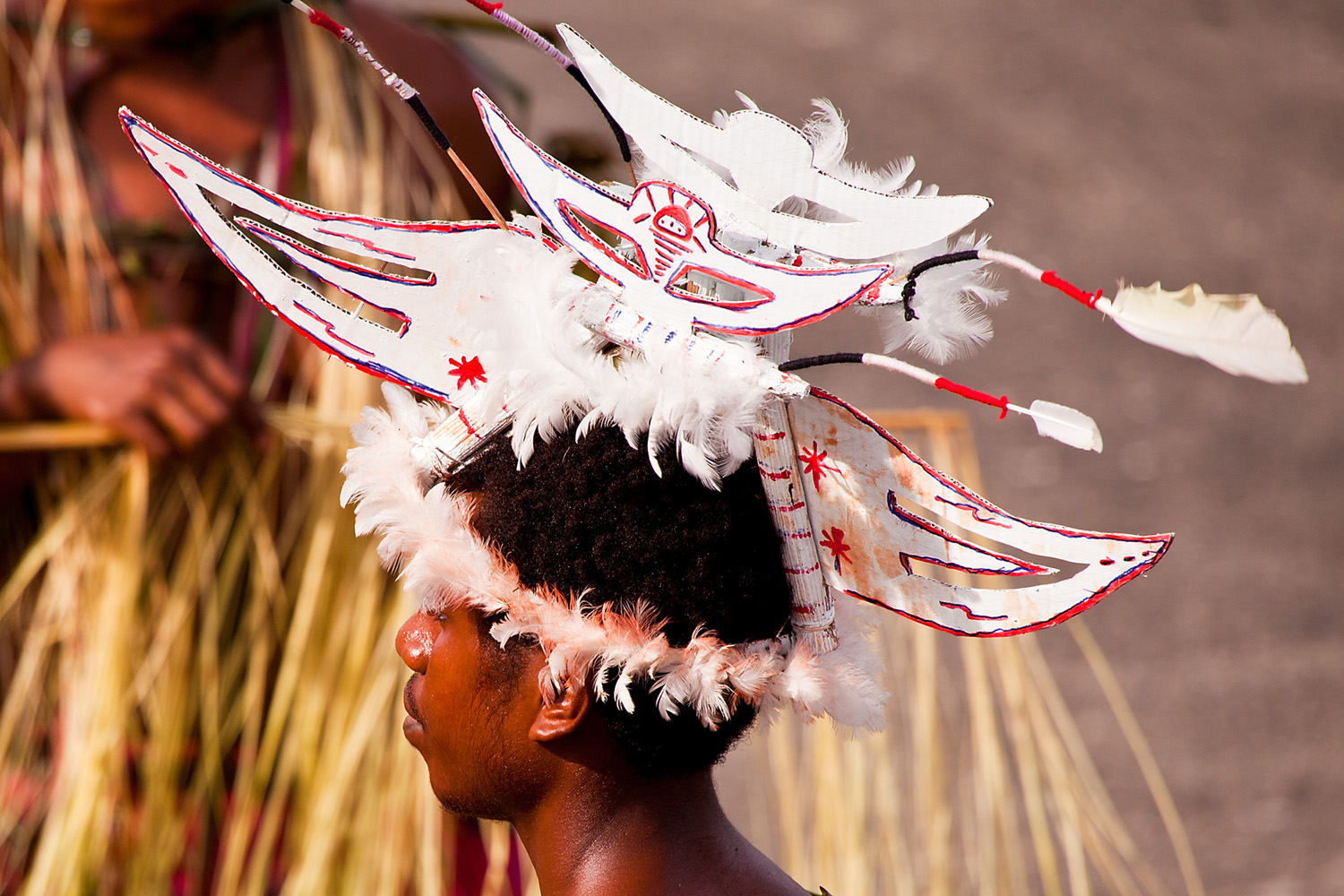
We are ready with all our gear at the disembarkation point near reception on Deck 4 at 08:45. There’s a small cultural welcome taking place on the dock below but it’s really not anything like the fantastic welcomes we’ve experienced in the small villages and islands we have already visited. This group’s costumes look a little makeshift as you can see from the headdress worn by this dancer.
Symbolic Headdress

Finally we are cleared to disembark and eight of us head down the stairs to the waiting minibus. The plan is to head to the Madang Resort, where Niugini Dive is located, get our gear and then head out for two dives.

It’s only a ten minute drive to the resort and in no time we’ve signed our indemnity forms relinquishing the organisers of any responsibility for our wellbeing and have had our BCD’s (Buoyancy Control Device) assigned. Now we are walking down to the local dock where the small dive boat is waiting for us.

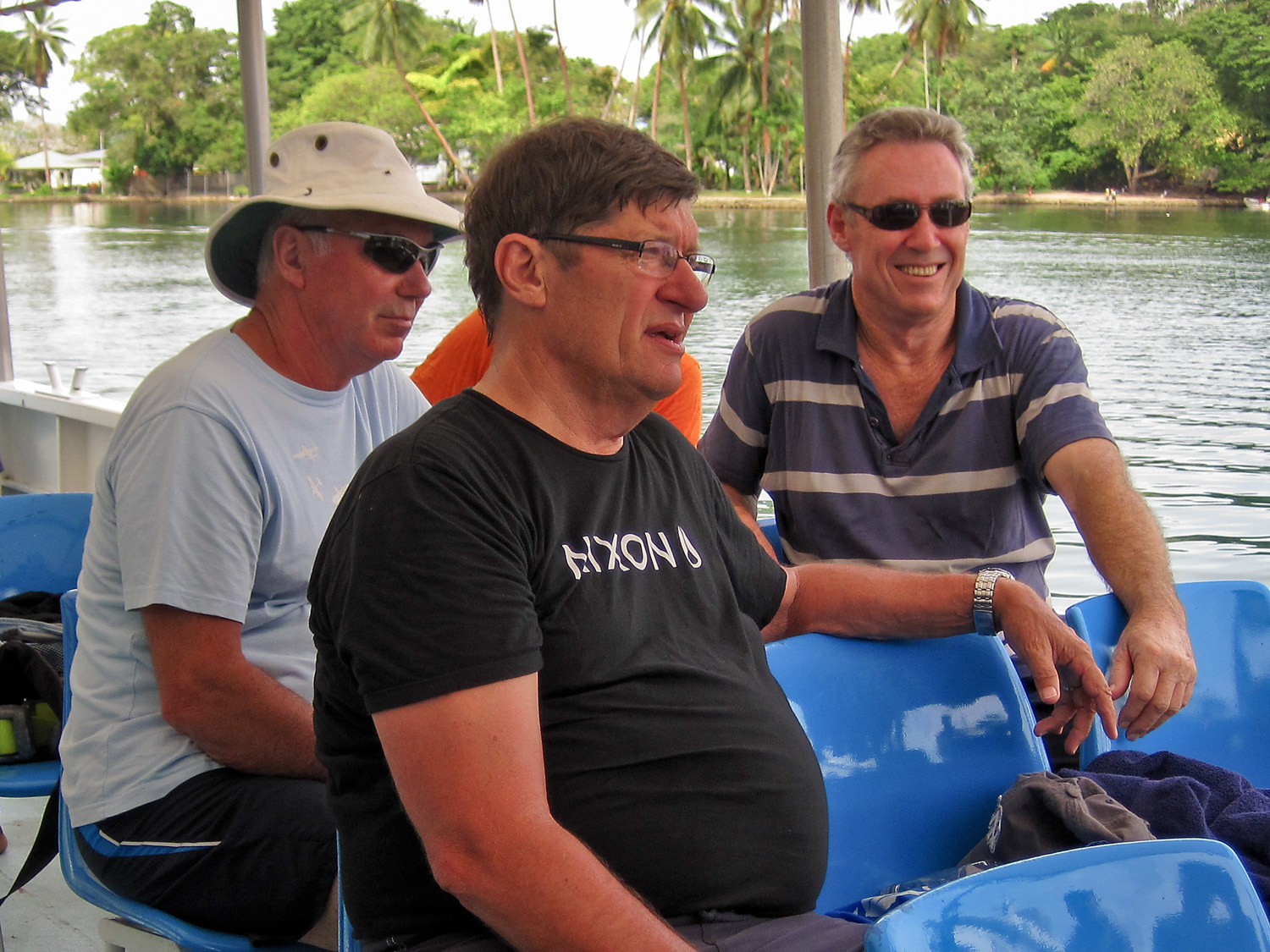
We climb aboard and take our seats, aside from the eight of us there are three other guys diving today.
Fellow passengers from the Orion

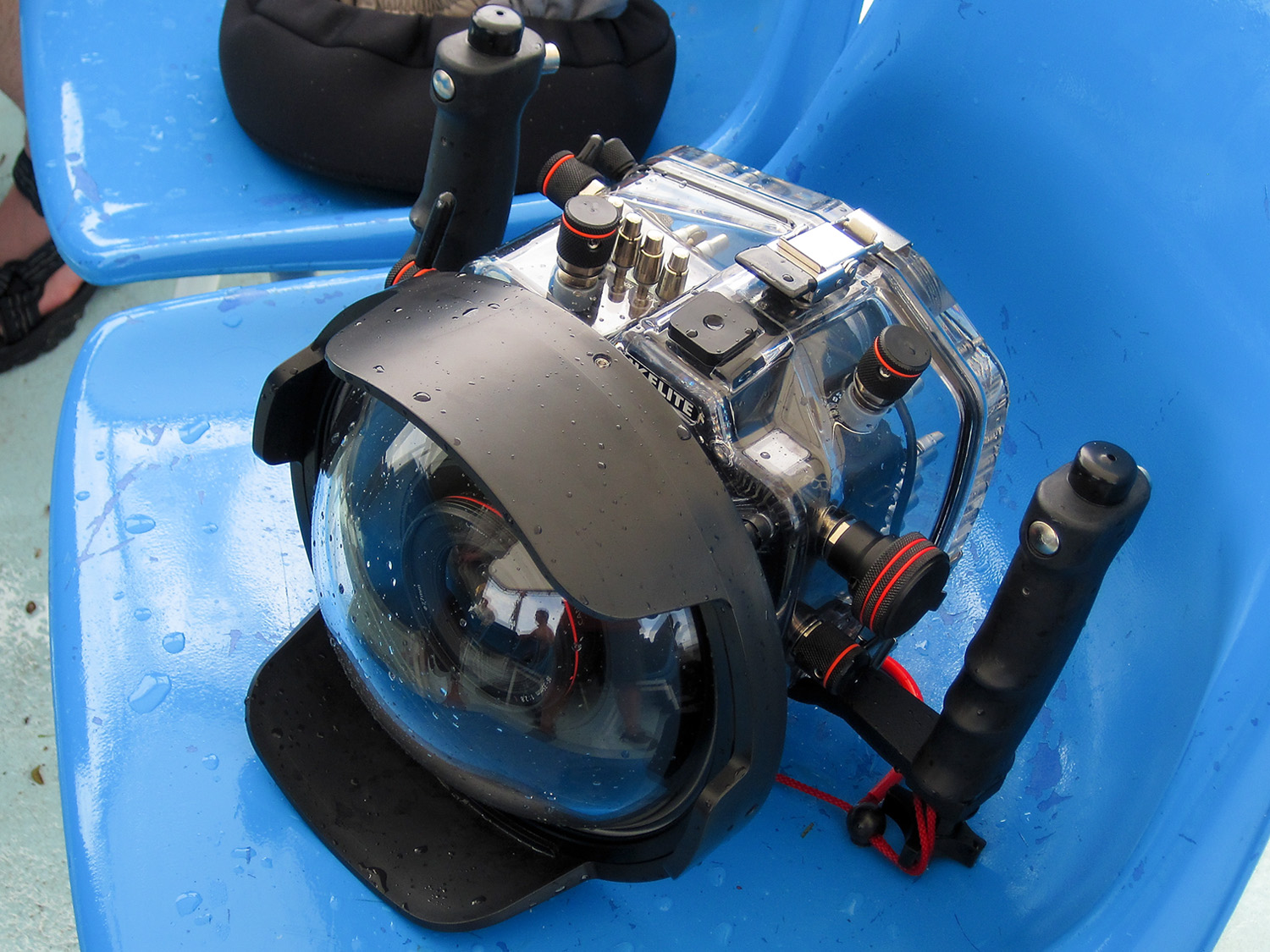
One of these other guys joining us has a very impressive piece of photo kit with him. It’s a Canon 5D Mark2 in a special waterproof housing. I’ve never seen one before so I have a bit of a chat with him and he tells me he’s never dived with it before.  He rented it to try it out and he’s a bit concerned that it’s going to be completely watertight.

We arrive at our first dive site, a reef about 30 minutes from Madang. The chap with the camera doesn’t waste anytime and he’s one of the first in the water.
Young guy with camera
Waterproof camera housing

During our initial setup at the Madang Resort we had spoken to the dive masters and told them that we hadn’t dived for about 17 years but that we’d done a refresher course just before we left Sydney.

Once we reached the reef one of the dive masters made a point of staying with just Kelly and myself to make sure we’d be okay and to gauge how well we could cope with different depths. The other guys in our group had had quite a bit of experience so they went in before us.
Bruce waiting for everyone to join him

A few minutes later we were in the water and descending toward the reef. I was a bit concerned about Kelly as she’d only managed to complete the first day of the refresher course, but I needn’t have worried as she was having a great time and had no issues diving at all.

We spent a great 45 minutes or so diving the reef, the conditions weren’t the best, but it was still a great deal of fun. We’d been told to leave a bit of air in our tanks but I seem to be a heavy breather under water and toward the end of our dive the dive master gestured for me to take his auxiliary regulator and use his air to conserve mine. So the last 5 or 6 minutes while we stopped for decompression he and I were very close!
View back to mainland from the dive boat

After we’d all climbed back on board, there’s quite a bit of discussion as to the tide, diving conditions and dive locations we could go to next. The dive master say well go look at a couple of spots and we head off across the bay. At each stop he puts on some goggles and dives overboard to check out the conditions. Unfortunately it’s not looking good as the tides are bringing in quite a lot of stuff in the water. In the end a vote is taken and we all opt for the B25 bomber dive.

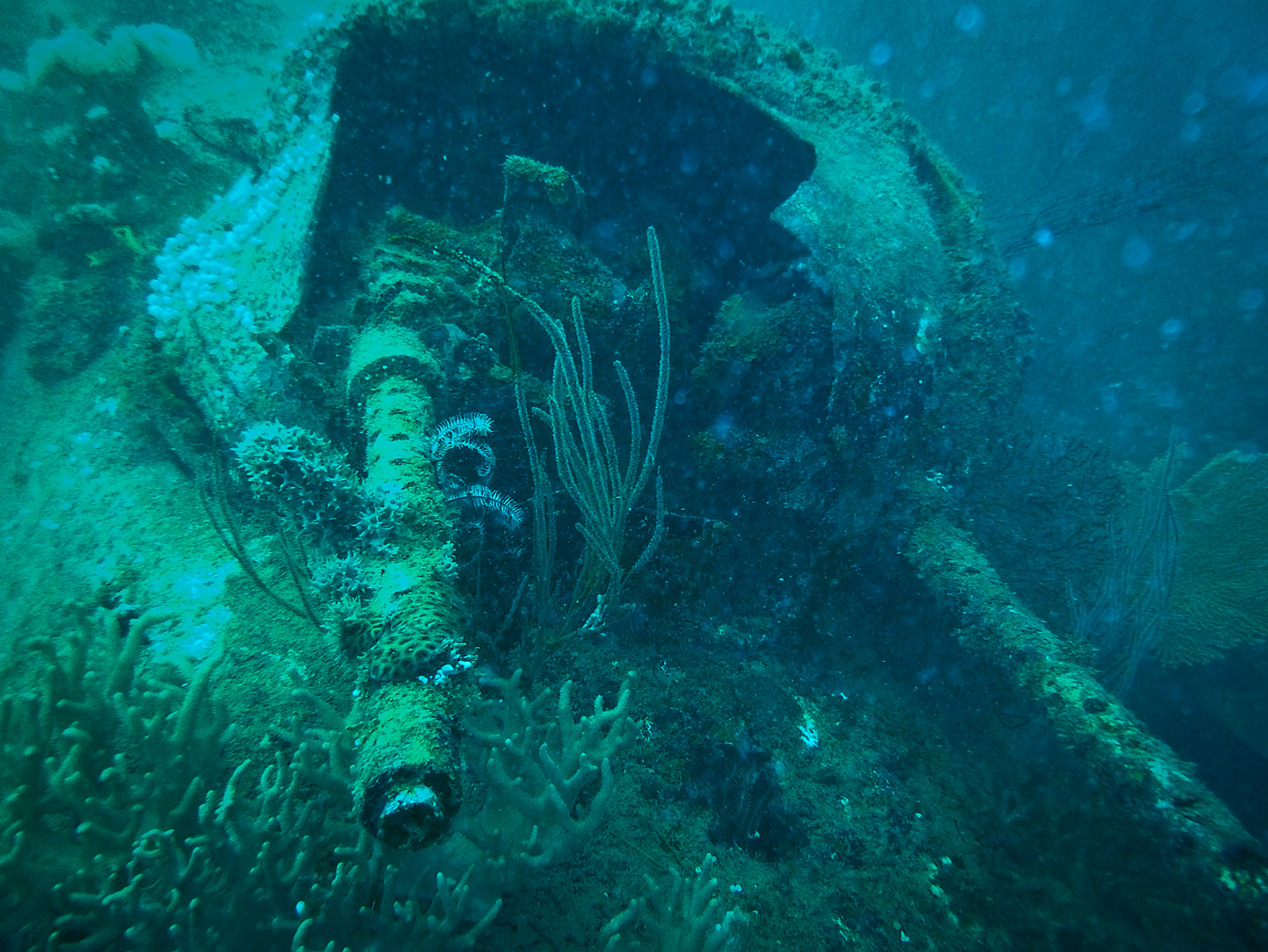
The dive is an old World War II wreck of a B-25D-5 bomber “Green Dragon”. During the war it took off near Port Moresby on a barge sweep and strike against Madang Airfield. It was damaged by anti-aircraft fire and it ditched between Wongat Island and the coast of New Guinea.

Of the crew, the Engineer died in the crash. The rest of the crew swam to Wongat Island where they were captured by the Japanese. The Command Pilot Major Cox was separated from them and flown to Rabaul then transported to Japan where he spent the war as a POW. The other four crew members were blindfolded, escorted to an execution ground, bayoneted, then beheaded!
A chap named David Pennefather discovered the plane in September 1979 while snorkelling off Wongat island.

It took us about 20 minutes to get to the wreck site and we suited up again. The other guys would go first and we would go with our dive master. The main body of the plane is in about  18 metres of water while the starboard wing is at 25 metres.
Our dive master

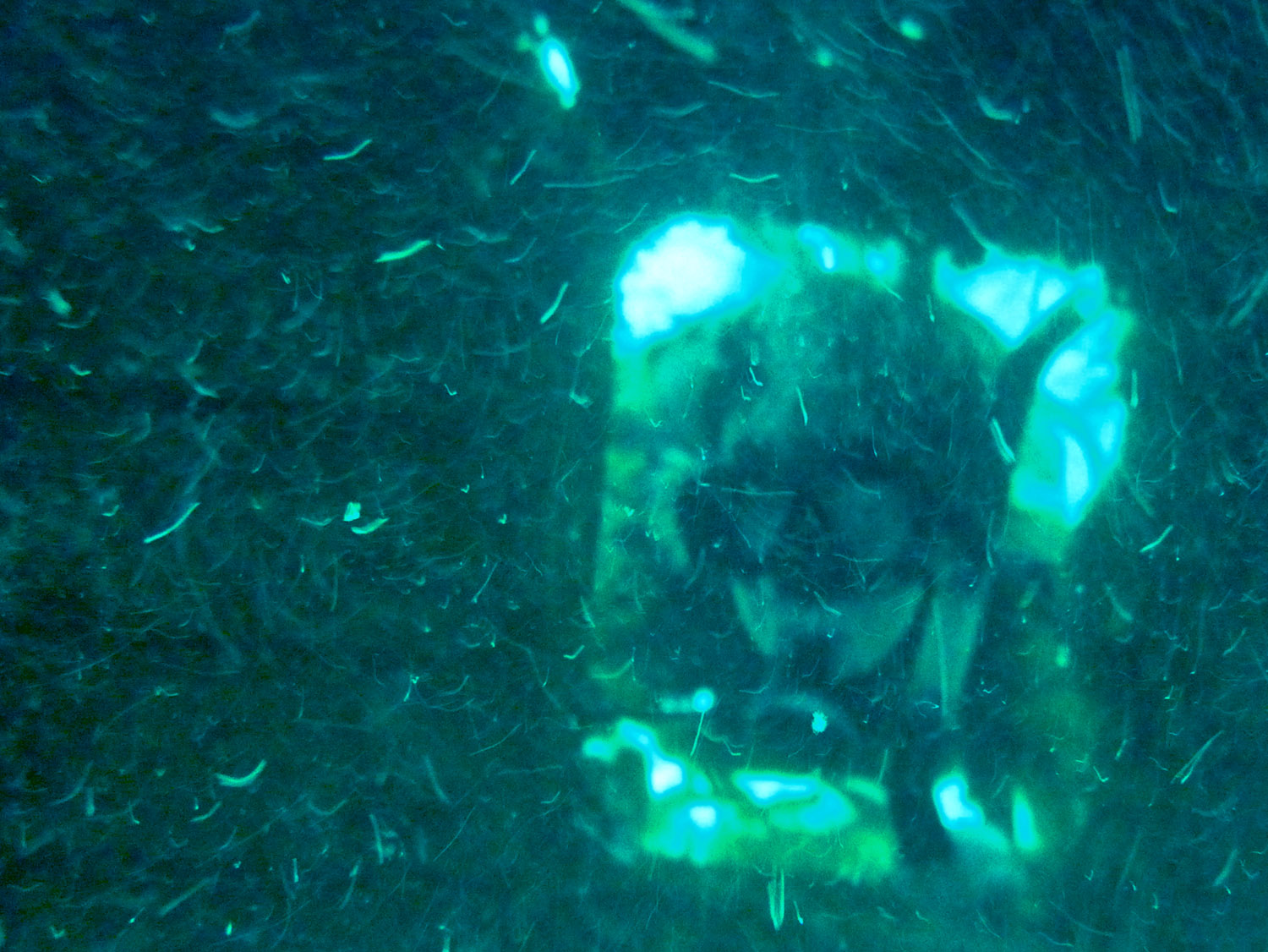
After the initial group descended it’s our turn and over we go. It’s pretty poor visibility but below us we can see the shape of the plane. We descend down to about 18 metres and follow our dive master as he takes us around the wreck. I have to say it’s pretty cool, the plane has lots of sponges growing on it and there are fish all around. It’s also quite crowded down there with everyone diving around the same spot. At one point the dive master manoeuvres Kelly toward the cockpit, which is completely open and where you can still see the controls and joysticks, and helps her get right into it, very cool. There are some very good photographs in the forum at Scuba.com.


Top Turret Machine Guns
Kelly framed by a window in the fuselage

After another 45 minutes diving, this time I was much more careful with my breathing so I didn’t need to use anyone else’s air, we made our way back to the surface. As we talked about our experience on the way back to the resort we both realised that it had rekindled our desire to do more scuba diving.

Arriving back at the resort we dropped the gear, thanked the dive guys and headed back to the Orion. Now my presentation is at 14:00 and we had only arrived back at 13:00 so Mike Fogg was a bit concerned I wouldn’t have time to set up but I assured him everything was okay and Kelly and I dashed off to get all the gear ready for the presentation.

I’d prepared a presentation and all the files the night before so I was in pretty good shape. It was primarily a matter of setting up the laptop and having everything ready to go.

At 14:00 I had an audience of about 27 and was ready to go. I’d planned the presentation to cover the three main areas that creating 360 Panoramas require you to work in. That is shooting panoramas, stitching panoramas and delivering those panoramas in Virtual Tours.

I talked about what a 360 Panorama is and showed examples taken while in the Tufi Village tour. The different types of Panorama images such as Circular or Cubic and the equipment you need to shoot them.

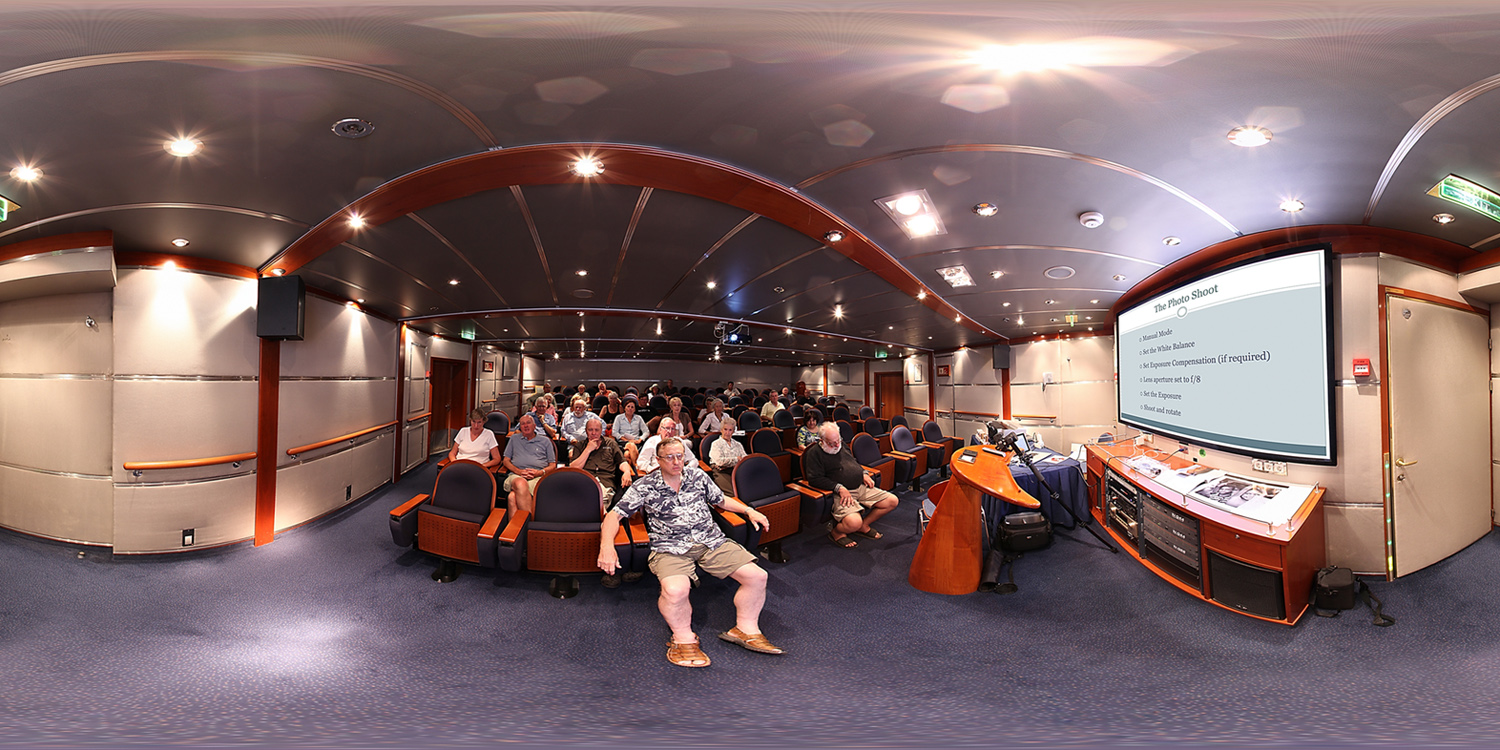
The next step was to discuss composing Panoramas to maximise the effect and I followed this with a real-time shoot within the lecture theatre.
Lecture Panorama (everyone was paying attention except the old guy asleep in the front row!)

After the presentation, there was a two hour break until Peter Eastway’s presentation “Photoshop and Layers” at 17:00. One of the guys from the dive shop who was working on the boat had been showing some artefacts that we really liked. When the boat got back we couldn’t find him and we were a bit sad that we’d missed out on them.

There was still a shuttle bus running between the Orion and the Madang Resort so Kelly, Peter and myself decided to catch the last bus back and see if we could find the guy from the boat.

At the resort they told us he was actually down by the docks where the Orion was berthed hoping we would see him there. As we had plenty of time before Peter was on call next we decided to walk back to the ship.

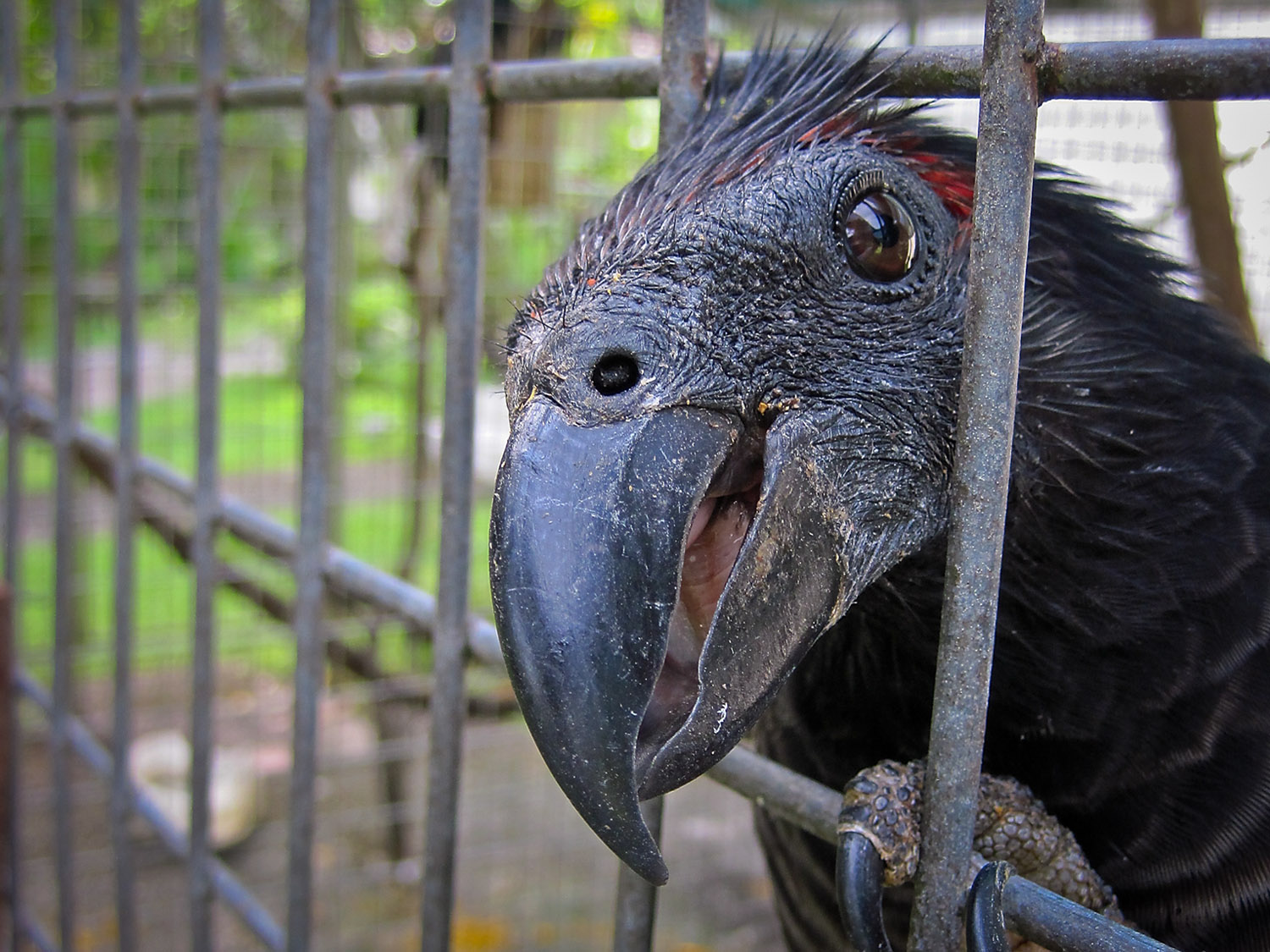
In the resort there was a sad sort of zoo with some caged animals including some very sick looking tree kangaroos. Not a great spot to visit.
Black Cockatoo at Mandang Resort
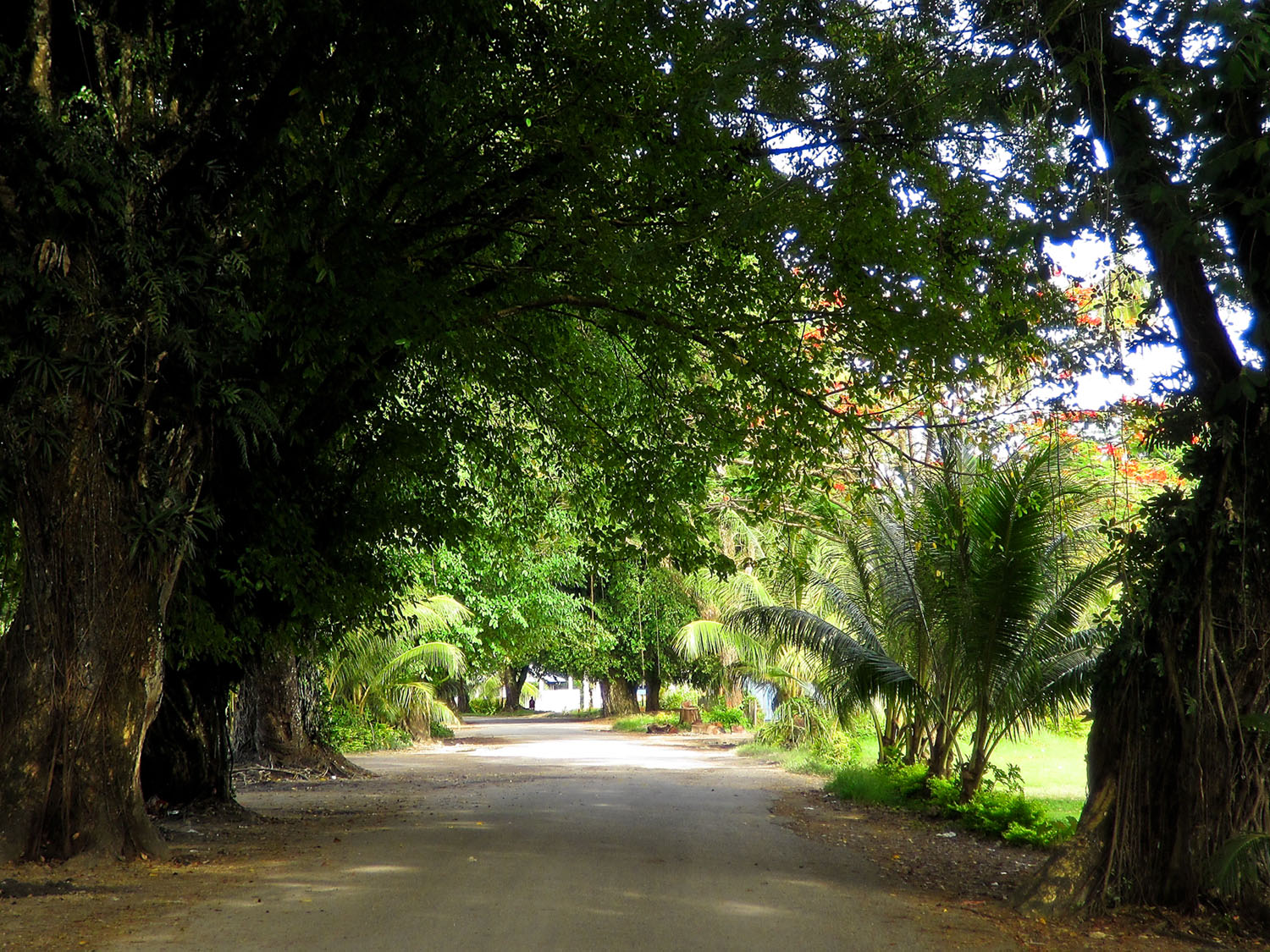
The weather was beautiful and being a Sunday the town was almost deserted.  We walked back along a wide avenue flanked by trees past an old club and back to the dock where we caught up with the guy from the boat and bought our artefacts.
Avenue of trees
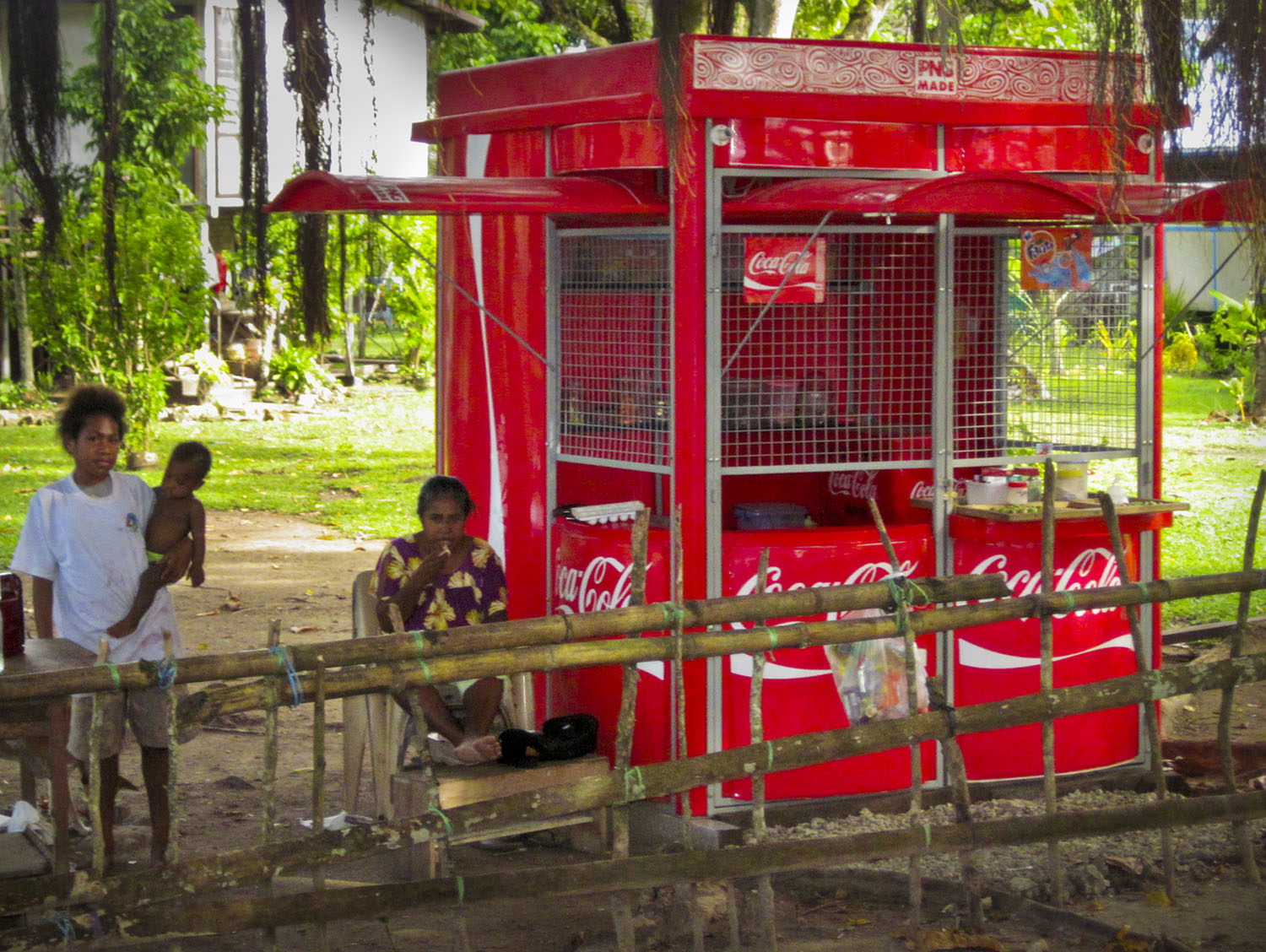
Coca-cola stand

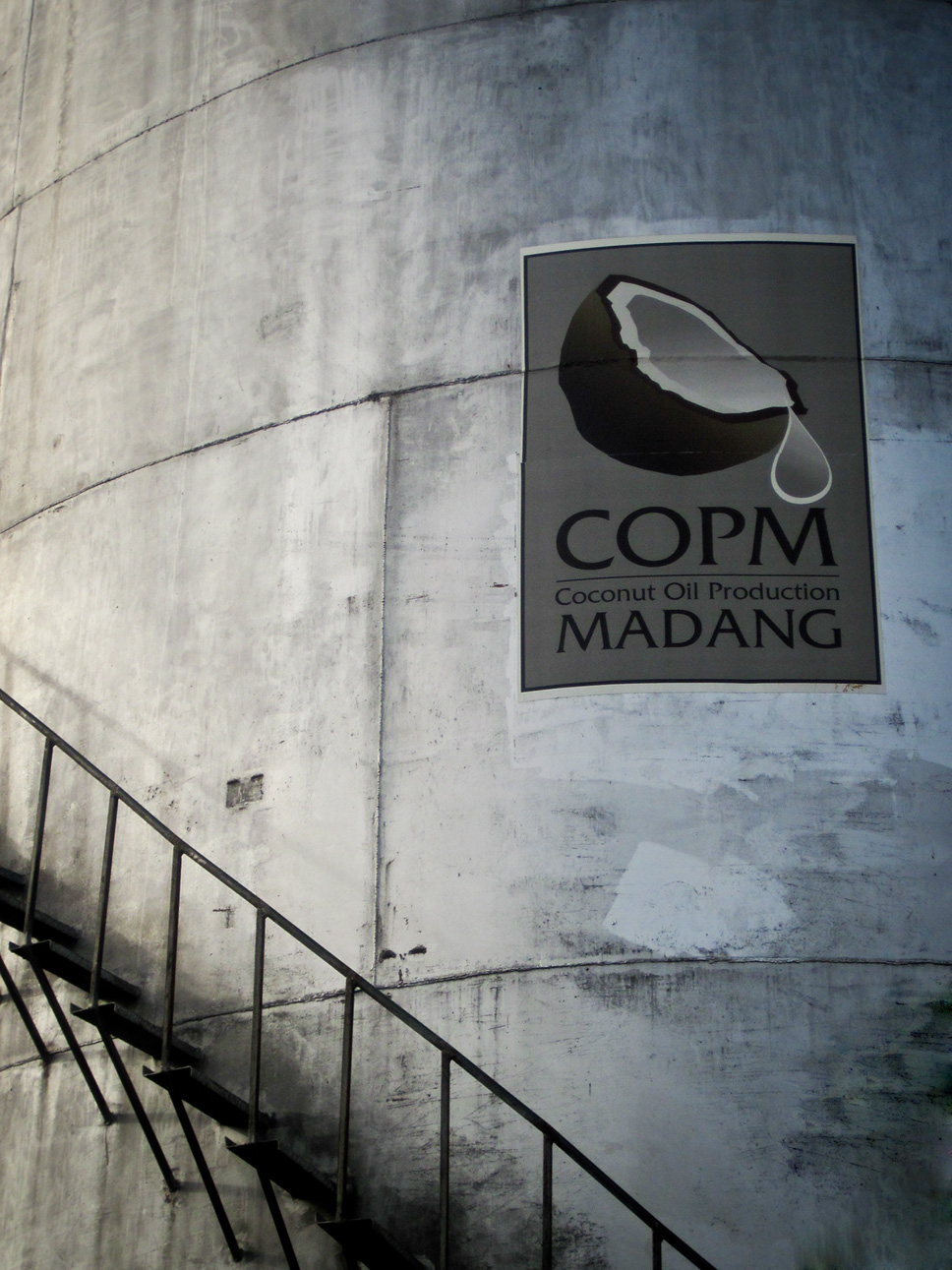
Near the docks is the ubiquitous Copra works and the large silo that contained the refined Copra.
Copra Silos
Stack of bags in the Copra works

Back on board we had time to grab a coffee and get settled in for Peters lecture on Photoshop and how he uses layers to bring the image back to what he saw when he was shooting it. Once again a great presentation and more grist for the mill.

The day wound down with another recap from the Expedition Team and we finished the day with a bit of room service.

Day #8 New Guinea Adventure

Tami Islands

Overnight we have travelled north from Tufi and have have arrived quite early, 07:30, at the Tami Islands.
The Orion anchored off Tami

The Tami Islands are a small group of islands, located about seven nautical miles off the Huon Peninsula, in the Solomon Sea. The islands include four atolls,  two very small and one not much larger than a strip of sand.

Map of the region showing our headingGoogle map link

Today we will be doing a wet landing at one of the islands for a welcoming ceremony, a chance to meet the villagers and the opportunity to take a walk through the village.
After breakfast, at around 09:00 ,we assemble in the Delphinus Café for our zodiac ride ashore. As in other landings like this we must all arrive at the same time, or within a few minutes of each other.
We make our way to the shore and then walk from the beach about 500 metres into a large clearing in the village. There is a shaded area with bench seating and an esky or two full of bottles of cold water. It’s only early but the sun is high and it’s already very hot.

From the bush we can hear the sound of drums and into the clearing come a large group of men and women dancing and singing.
Welcome Ceremony

As in other welcomes the performance is fantastic, with rhythmic drumming and the movement of headdress, grass skirts and feathers combining to create a visually rich experience for all of us.
The performers make their way from the jungle further into the clearing. Peter and Nick take full advantage of the welcome to film and photograph the performers.

Peter and Nick

After the initial welcome one of the young women, beautiful in her traditional costume, comes forward from the group to address us and formally welcome us to the island.
Welcome speech

After the speech, the drummers were back and the performance really began.

Drummer Man

One of the most fascinating features of their costumes were the large and distinctive headgear they wore.  I was interested in the symbolism of it and found out that they represented the Eagle. Once I knew that it was easy to see the shape of the eagle’s tail, wings and head.
Eagles symbolised in the Headdress

It’s been amazing to see the different ornaments and adornments the dancers and singers wear and the colors of the skirts and flowers make the opportunity to experience these welcomes unique.
Intense colours of the costumes

A number of young girls also took part in the welcome carrying their small woven baskets.
Young dancer

We weren’t the only ones interested in the dancing and there were a lot of villagers watching from the wings including this young one.
Young villager watching the performance

After the performance we had about an hour before we were due to leave so we left the performance area and headed back into the village. The village seemed to be built out of every imaginable type of material salvaged by the villagers. This results in a textural landscape of rusting metal, netting and palm fronds.
Building textures

We were fortunate to be taken in hand by an elderly woman of the village who took it upon herself to be our guide. She took us on a private tour of the village, down past her house, showing us where she cooked, and through to the cemetery where her sister and brother were buried.
Our guide
The Kitchen

What we saw when walking into the cemetery was quite unexpected. There were quite a few graves and most of them were defined by simple wooden grave markers but what was unusual was that most of the graves were defined by upturned bottles pushed almost flat to the ground. She told me that the bottles had been left on the island after the war by the Australians and Americans.
Island graves
I found this lone grave marker and bottle in the roots of a large tree not far from the cemetery.

Isolated grave marker
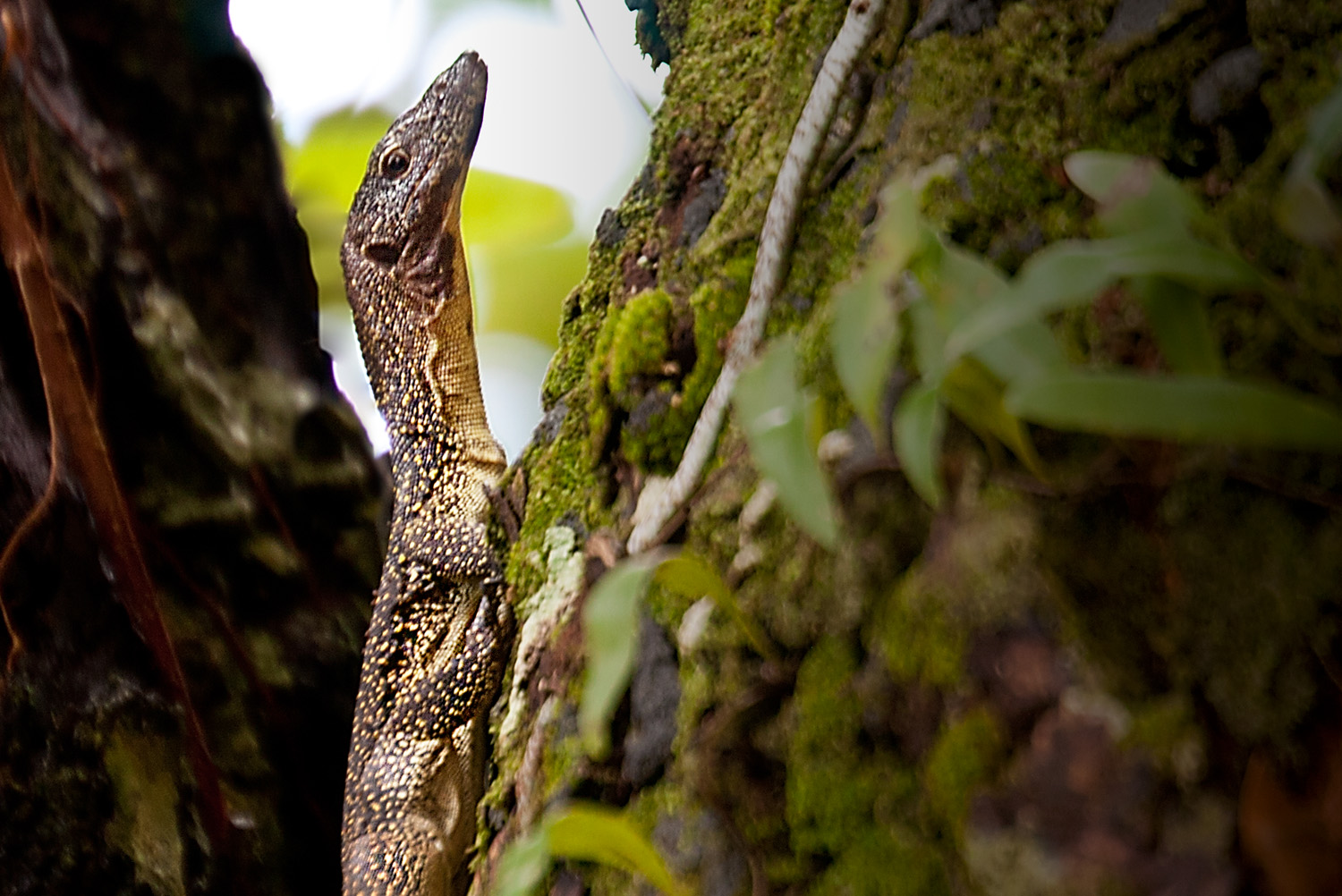
On the way back to the beach I spotted a lizard scrambling up the trunk of one of the large trees planted throughout the village.
Lizard (type unknown)

Just before we went down to the beach, we talked to some of the kids that were interested in us and gave them some of the bubble blowers we’d brought with us. For the life of me I couldn't get it to work but this young girl managed it first time.
Young girl blowing bubbles

The Orion team has arranged a special treat a “sumptuous” beach BBQ lunch at the small coral cay not far from the island we are on. Before we head over there I want to head back to the Orion so we can pick up my Panorama gear so I can shoot a pano on the island and our snorkelling gear.

We hop into a zodiac and push off from the island for the trip to Orion. Just as we turn who should we see but Justin, in all his New Guinea finery, driving his own zodiac!
Justin (the new zodiac driver)

We arrive back at Orion, collect all our gear, slap on some sunscreen and are back on the Marina platform ready to board a zodiac for the beach bbq in under 15 minutes. We head out for the short trip to the island and we haven’t gone more than a few metres from Orion when all around the zodiac we can see dolphins tracking alongside just under the water. Suddenly they are leaping out of the water and zipping back and forward in front of the zodiac. What a sight. They swim along with us for quite a while until the water becomes too shallow for them.

The ride into the cay is beautiful, the sky an iridescent blue and the water crystal clear. Because the reef is so high in the water we have to navigate through some buoys set up by the scouting team so our prop doesn’t hit the reef.

Riding the zodiac to the Coral Cay

The beach itself is tiny and leads you up to a rock wall that frames the whole beach.  Just in front of the wall the guys from the restaurant have set up their beach bbq. They were right in calling it sumptuous,  there are two canopies set up, one with a bbq and the other with salads and accompaniments. Strung along the wall there are strands of flowers and everyone is having a great time.
Orion Restaurant Team

After lunch we head for the water to do a bit of snorkelling, we also try a bit of kayaking but the current between the islands is really strong and basically we end up going around in circles.
It’s almost 13:00 and the last zodiac is set to leave at 13:30 so Kelly and I head for the water to cool off. It’s quite shallow so we walk out quite a way into the channel. There’s a young boy in a dugout hanging out just around from the beach area where the bbq is set up and the view down the channel is beautiful. There is a lovely overhang at the end of the island with a palm tree perched right on the end.
Island Silhouette

We spend the last few minutes just enjoying the beauty of the scene around us before heading back and catching, once again, the last zodiac back to Orion.
Kelly loving the moment

Back on board we headed up to deck 6 to wash out our gear and spend a bit of time in the Jacuzzi. Once again it’s just the perfect thing to relax before our next event at 17:00 a lecture by Peter Eastway entitled on ‘Rock Hopper – Islands of the Southern Ocean”.

Wow! what a fantastic presentation. Peter showed incredible images that reinforce the beauty of the Islands of the Southern Ocean. He showed us images of snow capped peaks, deep blue glaciers and minke whales. These images definitely show why Peter is one of Australia's leading landscape photographers. View all of the images on Peter’s website and if you are in Sydney between the 19th and 30th May make sure you head down to Gaffa Gallery to see his exhibition.

I walk out of Peter’s presentation really inspired to lift the values of my images, I’m so thrilled that both Peter and Nick are on this trip.

Kelly and I finish off the day with a bit of room service and another episode of Breaking Bad.